
Why the Final Week Deserves Its Own Plan
The days immediately before an exam are high-stakes but often poorly managed. Many students either under-prepare - assuming they know enough - or overcorrect by attempting to absorb entire semesters of material in 48 hours. Neither approach serves performance well.
Research in cognitive science consistently points to the same conclusion: what you do in the final week matters less about total hours logged and more about how you use that time. Targeted review, adequate sleep, and reduced anxiety produce better recall than marathon cramming sessions that leave you exhausted on exam morning.
If you haven't yet built a longer-term study routine, see our guide to building a study schedule - but if the exam is already close, this checklist is where to focus now.
Use the items below as a practical audit. Work through each group in order, ideally starting five to seven days before the exam date.
Academic Review
Logistics and Exam Day Preparation
Sleep, Nutrition, and Physical Wellbeing
Mindset and Stress Management
Tools and Resources to Have Ready
Before you begin your final-week review, gather the materials and resources listed below. Having everything in one place prevents wasted time hunting for notes or scrambling for logistics information mid-week.
Course Syllabus and Exam Guidelines
Confirm exact exam scope, permitted materials, and any instructor instructions before beginning your final review.
Flashcard or Spaced-Repetition App
Use for active recall practice on key terms, formulas, or concepts throughout the final week.
Past Exams or Practice Questions
Simulate real exam conditions to identify weak areas and practice time management under pressure.
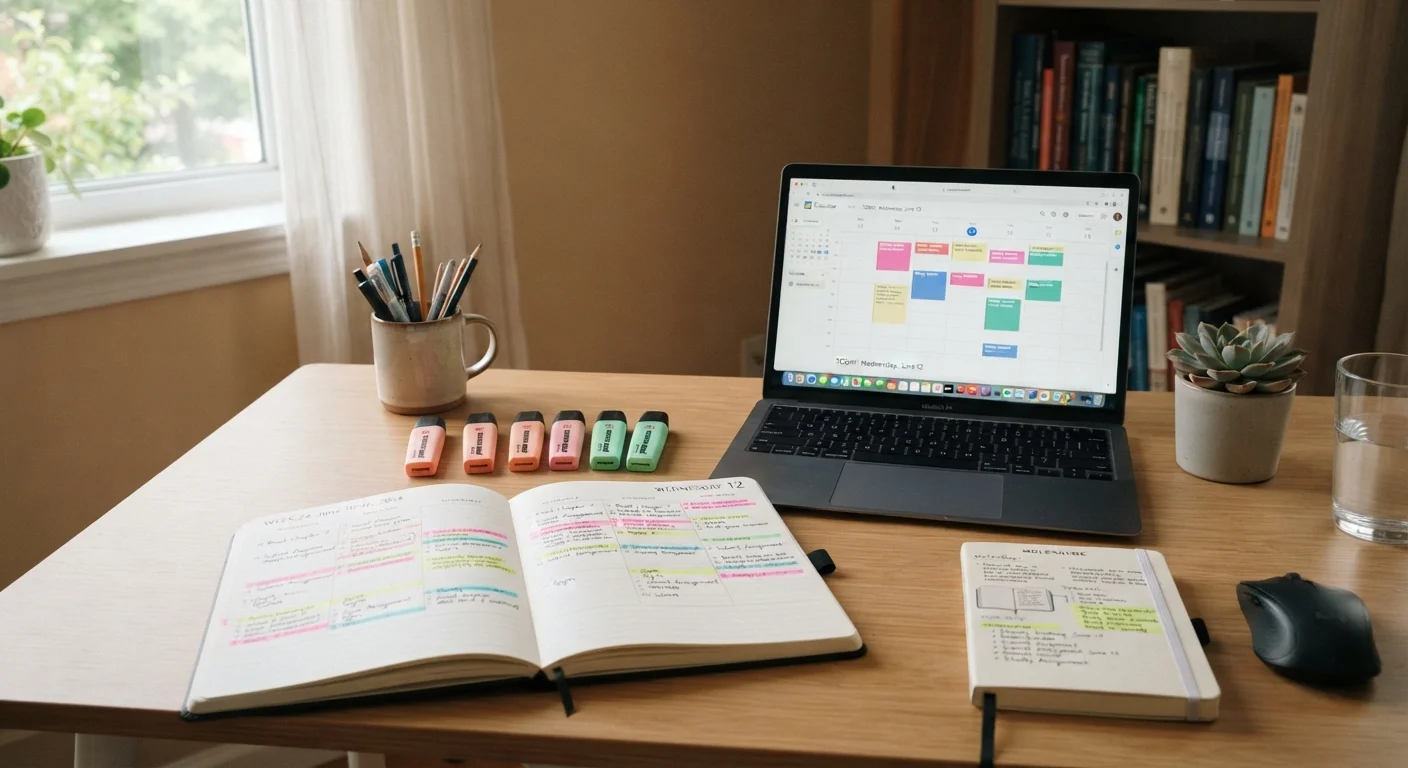
Planner or Calendar
Map out daily review sessions, breaks, and logistics tasks across the final week to avoid last-minute scrambling.
Quiet, Dedicated Study Space
A consistent, distraction-minimized environment improves focus and conditions your brain to associate the space with concentrated work.
Noise-Cancelling Headphones or Earplugs
Block ambient distractions during deep study sessions, especially in shared living environments.
Managing Stress and Mindset in the Final Days
Exam anxiety is a real, documented experience - not a sign of weakness or poor preparation. Mild stress can actually sharpen focus, but when it becomes overwhelming, it interferes with memory retrieval and decision-making at exactly the wrong moment.
The most effective approach is to treat mindset preparation as a non-negotiable part of your checklist, not an afterthought. That means scheduling downtime deliberately, not just collapsing from exhaustion. It means noticing unhelpful thought patterns - like catastrophising a single difficult topic - and redirecting your attention to what you do know.
For a deeper look at managing exam-related stress, our article on tackling test anxiety outlines evidence-informed strategies worth building into your routine. If stress management is something you want to plan for more broadly, building a personal stress response plan offers a useful framework.
Avoid All-Night Study Sessions
Pulling an all-nighter before an exam is one of the most counterproductive things you can do. Sleep deprivation impairs working memory, attention, and the ability to retrieve information you've already learned. Even a shorter-than-ideal night of sleep significantly outperforms no sleep at all. If you feel behind, prioritize the highest-yield topics and get to bed at a reasonable hour.
Don't Start Entirely New Material in the Final Days
Introducing large amounts of new content in the final 48 hours can interfere with what you've already consolidated. Use this time to strengthen what you know, not to patch major gaps from scratch. If there are topics you haven't covered at all, make a strategic decision about what is most likely to appear and focus narrowly rather than trying to cover everything.
On the evening before the exam, shift your focus away from new review entirely. Lay out everything you need - ID, permitted materials, directions to the exam location - and prioritize a full night of sleep. Memory consolidation during sleep is a well-documented mechanism; it is not optional if you want your preparation to pay off.
Know Your Exam Rules Before Day One
Arriving at an exam without a required ID, a calculator that isn't permitted, or the wrong type of pencil can cost you points or prevent you from sitting the test at all. Always verify permitted materials directly with your instructor or institution - don't rely on what worked for a different course or a classmate's recollection. Confirm these details at least three days in advance so there's time to resolve any issues.