What Crate Training Actually Is
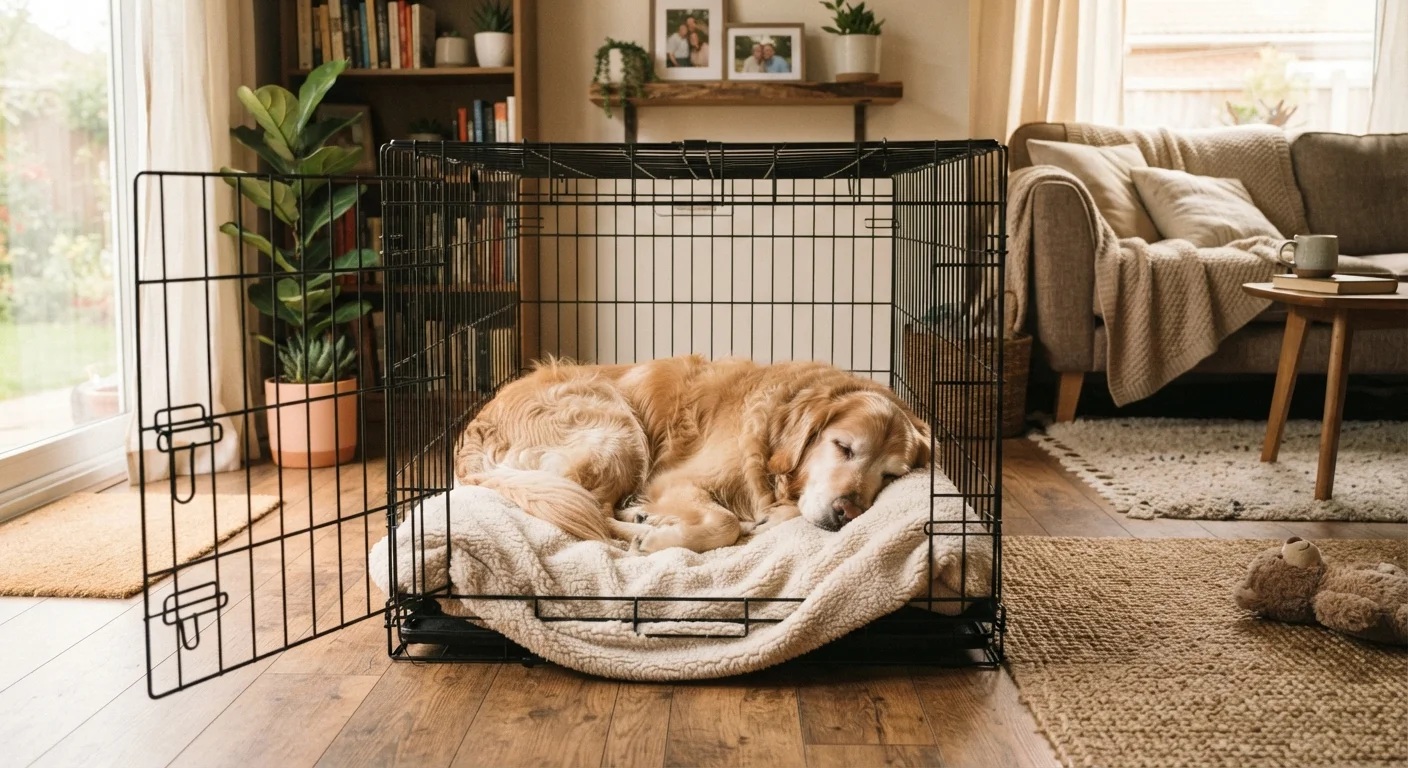
Crate training is the process of teaching a dog to accept - and ideally feel comfortable in - a confined space such as a wire, plastic, or fabric enclosure. The underlying principle draws on a dog's instinct to seek out small, enclosed spaces that feel secure, similar to a den. Done well, a crate becomes a dog's own retreat rather than a form of punishment.
The approach is commonly recommended during the early days of dog ownership, particularly for puppies who haven't yet learned household rules. Veterinary behaviorists generally endorse it when used as part of a structured routine that also includes adequate exercise, social time, and positive reinforcement.
It's worth separating crate training from simple confinement. Locking a dog away for long stretches without preparation or positive association is not crate training - it's isolation, and it tends to produce the opposite of the intended results.
The Real Benefits
Supports faster, more reliable housetraining
A properly sized crate leverages a dog's instinct to keep their sleeping area clean, giving owners predictable windows to establish outdoor bathroom habits.
Provides a secure, calming personal space
Many dogs voluntarily retreat to their crates when stressed or tired, treating it as a sanctuary - particularly when the introduction has been positive and gradual.
Keeps dogs safe when unsupervised
A crate prevents access to hazards such as electrical cords, toxic plants, or foods left on low surfaces during the short windows when direct supervision isn't possible.
Eases veterinary and travel confinement
Dogs already crate-trained adapt far more calmly to transport kennels and post-surgical rest requirements, reducing stress during an already difficult experience.
Protects household property during the learning phase
Puppies and newly adopted dogs exploring boundaries can cause significant damage; short, supervised crate periods limit this while training progresses.
Housetraining is probably the most well-established use case. Dogs are naturally reluctant to soil the space where they sleep, so a correctly sized crate (just large enough to stand, turn, and lie down) gives owners a reliable window to take a puppy outside at predictable intervals.
Crates also help during post-surgical recovery, travel, and emergencies such as natural disasters, when a dog needs to be confined safely. A dog already comfortable with a crate adapts to these situations with far less stress than one encountering confinement for the first time under duress.
The Genuine Drawbacks
Overuse causes physical and psychological harm
Extended daily confinement limits movement, social interaction, and mental stimulation - all of which are essential to a dog's welfare. Chronic overuse is associated with increased anxiety and behavioral problems.
Does not address the root cause of anxiety
A dog with separation anxiety confined in a crate may escalate distress behaviors rather than calm down; the crate treats the symptom of destructive behavior without resolving the underlying emotional state.
Can create negative associations if misused
Forcing a dog into a crate, using it as punishment, or introducing it too quickly can result in lasting fear of confinement that is difficult to reverse.
Not suitable for every dog
Some adult rescues, dogs with past trauma, or breeds with high social needs may never comfortably accept crating, and attempting to force compliance can worsen welfare outcomes.
Requires significant owner time to introduce properly
A thorough, positive crate introduction takes days to weeks of consistent effort - an investment that is not always realistic for busy households.
The biggest risk is overuse. A dog left crated for eight or ten hours while their owner works a full day is not being given a den - they are being deprived of movement, stimulation, and social contact. This can contribute to muscle weakness, behavioral frustration, and, in some cases, anxiety disorders. Most veterinary guidance caps routine daytime crating at four to six hours for adult dogs; puppies need breaks far more frequently.
Equally important, crates do not solve the root cause of most behavioral problems. A dog that chews destructively due to anxiety or boredom will not improve simply because they are confined - the underlying issue requires behavioral support, exercise, and sometimes professional guidance. If your dog shows signs of distress when left alone, consult a veterinarian or certified applied animal behaviorist before relying on a crate as a primary management strategy. You can also learn to read the signals early by recognizing the subtle signs that your dog is struggling.
Crates Are Not a Substitute for Exercise
A dog that receives adequate daily physical exercise and mental enrichment will generally settle in a crate far more readily than one that is under-stimulated. Before increasing crate time, review whether your dog's overall activity and enrichment needs are being met. No amount of crate training compensates for a dog that is simply not getting enough to do.
Common Pitfalls and How to Avoid Them
4-6 hrs
Maximum recommended crating duration for adult dogs
Most veterinary behavior guidelines suggest adult dogs should not be crated routinely for more than four to six hours during the day.
Every 1-2 hrs
Recommended break frequency for young puppies
Puppies under 12 weeks generally cannot hold their bladder longer than one to two hours, requiring frequent supervised breaks outside the crate.
Using the crate as punishment is perhaps the most damaging mistake. If a dog is sent to the crate after a scolding, they associate it with negative emotions - undoing any progress and making future use far more difficult. The crate should always be introduced with calm encouragement and rewarded entry.
Skipping the introduction phase is another frequent error. Expecting a dog to settle calmly in a crate on day one - especially a rescue animal with an unknown history - is unrealistic. A proper introduction is gradual: the door stays open at first, meals are fed near and eventually inside the crate, and the dog sets the pace. Rushing this process produces resistance and fear, not acceptance.
Wrong sizing is also a common oversight. A crate that is too large eliminates the den-like quality and allows a puppy to use one corner as a bathroom. Crates should be sized to the dog's current body, not their projected adult size - or fitted with a divider panel during puppyhood.
For dogs with deeply ingrained avoidance of confinement - particularly adult rescues - the honest answer may be that a crate is not the right tool. Alternative management strategies, such as a puppy-proofed room or a pet gate, can serve similar safety functions without forcing an animal into a space they find distressing. Training philosophy matters here too; reviewing what the evidence actually says about dog behavior can help owners approach all training decisions with a clearer, more humane framework.