
The Illusion of Knowing: What Passive Review Actually Does
Most students have a default study routine: read through notes, highlight key phrases, and reread the marked sections. It feels productive. The material looks familiar. That sense of recognition, however, is not the same as the ability to recall and apply information under pressure.
Cognitive psychologists call this the fluency illusion. When text is already in front of you, your brain processes it with minimal effort, generating a feeling of comprehension. That feeling is real - but it does not reliably predict how well you will remember the material later. Familiarity and retrievability are different cognitive states.
Passive review - rereading, highlighting, re-listening to lectures - keeps information in your field of view. It does not force your brain to reconstruct it from scratch. That reconstruction is precisely what builds durable memory.
| Criterion | Active Recall | Passive Review |
|---|---|---|
| Core mechanism | Retrieving information from memory | Re-exposing yourself to existing material |
| Cognitive effort required | High - deliberately effortful | Low - minimal mental demand |
| Long-term retention | Significantly stronger | Weaker; fades quickly |
| Identifies knowledge gaps | Yes - gaps surface immediately | No - familiarity masks gaps |
| Common methods | Self-quizzing, flashcards, free recall | Rereading, highlighting, re-watching |
| Best used | After initial exposure; repeatedly over time | For first exposure to new material |
| Research support | Extensive and consistent | Limited for retention outcomes |
How Active Recall Works - and Why the Effort Matters
Active recall means closing your notes and attempting to retrieve information from memory before checking the source. This can take many forms: answering practice questions, writing everything you remember about a topic on a blank page (sometimes called a brain dump), using flashcards with the answer hidden, or simply asking yourself "What did I just read?" after each section.
The underlying mechanism is called the testing effect (also known as retrieval practice effect). Each time you successfully retrieve a memory, that memory trace is strengthened. Each failed attempt - followed by looking up the correct answer - also strengthens encoding, because the effort of searching creates a more memorable moment of learning.
This is why active recall feels harder than rereading. The difficulty is not a sign that the technique is inefficient; it is the mechanism through which it works. Research on retrieval and interleaving confirms that strategies perceived as more effortful often produce superior long-term outcomes.
~50%
More material retained with retrieval practice
Studies reviewed in Roediger & Butler (2011) in Trends in Cognitive Sciences found retrieval practice produced retention advantages of roughly 50% over restudying on delayed tests.
2-3×
Longer retention interval advantage
Research suggests the gap between retrieval practice and passive review grows larger the more time passes between studying and the final test.
Practical Ways to Apply Active Recall to Any Subject
Active recall is not a single technique - it is a principle you can apply across subjects and formats:
- Self-testing: After studying a section, write down everything you can remember without looking. Then check what you missed.
- Question-based notes: Convert your notes into questions as you write them. The Cornell note-taking method (see note-taking methods compared) builds this structure in from the start.
- Flashcards with deliberate retrieval: The key is to genuinely attempt recall before flipping the card - not to flip quickly and tell yourself you knew it.
- Teaching or explaining: Explaining a concept aloud - to a study partner, a study group, or even to yourself - forces retrieval and reveals gaps.
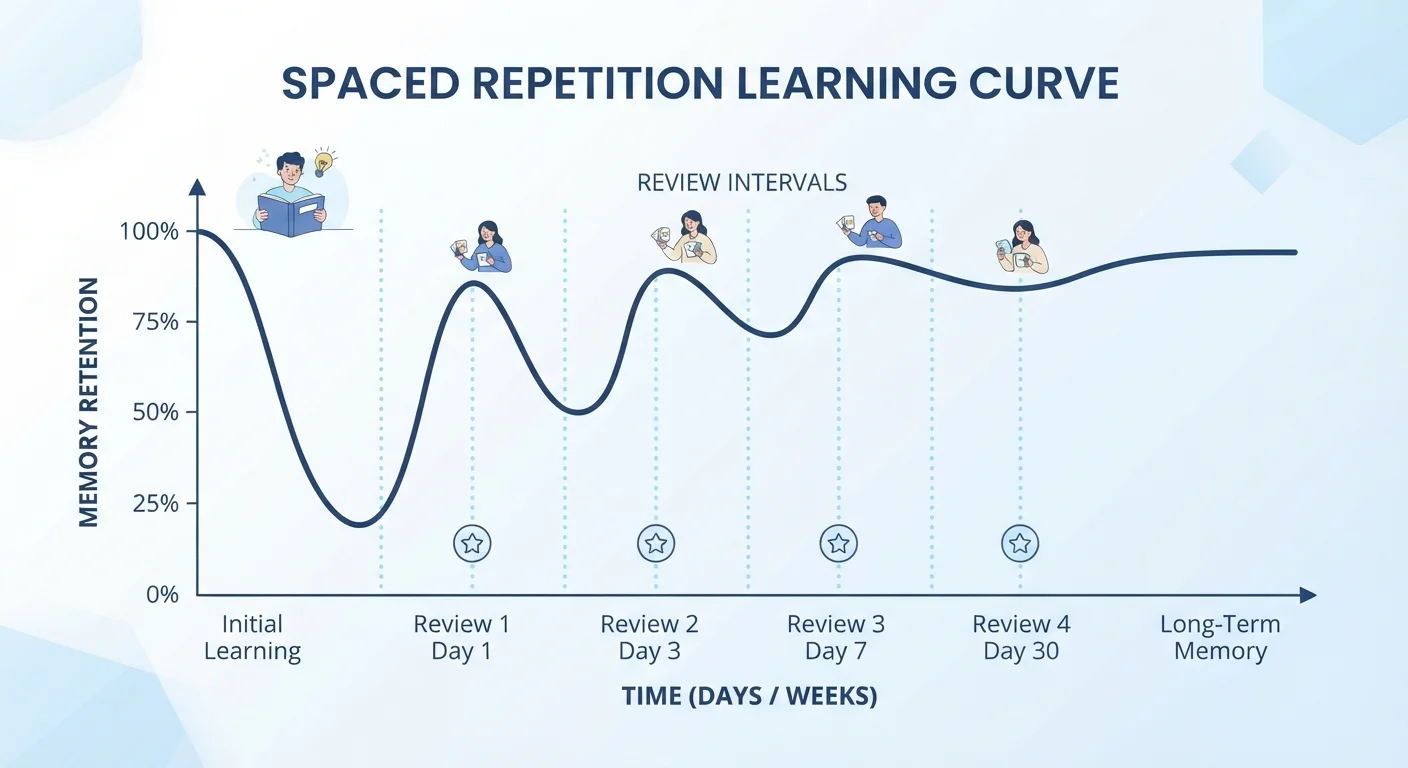
Pairing active recall with a spaced review schedule amplifies its effectiveness. Spaced repetition staggers practice sessions so that you revisit material just as forgetting begins to set in, reinforcing memory at its most vulnerable point.
When Passive Review Still Has a Role
Passive review is not worthless - it is simply insufficient on its own. There are two legitimate uses for it within a well-structured study plan.
First, an initial read-through of brand-new material is necessary before retrieval practice can be meaningful. You cannot retrieve information you have never encountered. The first pass through a chapter or set of lecture slides builds the rough schema that active recall will later strengthen.
Second, a brief review of your notes immediately before a focused retrieval session can reduce the frustration of drawing a complete blank - which can be discouraging for learners early in building this habit. The goal is to make passive review the launch pad, not the destination.
For adult learners applying these principles in professional or continuing education contexts, evidence-informed study habits for adult learners offers additional guidance on structuring sessions that fit busy schedules.
Active Recall Is a Skill That Improves with Practice
Many students find active recall uncomfortable at first because retrieving information feels harder - and less rewarding - than reading familiar notes. This discomfort is normal and tends to diminish as the technique becomes habitual. Starting with shorter retrieval sessions on smaller chunks of material can make the transition easier. Over time, most learners report that active recall not only improves retention but also reduces the total time needed to prepare for assessments.