
Why Most Study Schedules Fail
The most common reason study schedules collapse is not a lack of motivation - it is a mismatch between the schedule on paper and the reality of the student's life. Schedules built around an idealized version of a week (maximum focus, no interruptions, perfect discipline) are plans for a person who does not exist. Effective scheduling starts with an honest audit of your actual time, energy, and constraints.
A secondary cause of failure is vagueness. Telling yourself to "study more" is not a plan. Research on implementation intentions - the practice of specifying exactly when, where, and what you will do - consistently shows that specificity improves follow-through. Your schedule should name the subject, the task, and the time window for every session.
Understanding how personal learning habits form and stick can also help you see your schedule not as a rigid grid but as a scaffolding for a longer-term practice.
Overscheduling Is the Most Common Mistake
Students who pack every free hour with study time often abandon their schedules within a week. A schedule that leaves no room for meals, downtime, or unexpected demands will fail - not because you lack discipline, but because it was never realistic. Always leave at least 20-25% of your weekly hours unscheduled.
How to Build Your Schedule Step by Step
The following steps walk you through constructing a study schedule from scratch. Work through them in order - each step builds on the previous one. Before you begin, gather the prerequisites listed above.
What you will need
Map your fixed commitments first
Before you can schedule study time, you need a clear picture of what is already claimed. List every non-negotiable block in your week: classes, work shifts, commuting time, family obligations, and regular appointments. Enter these into your calendar first. What remains is your available time - not your free time, because free time must include rest.
Identify your peak focus hours
Not all study hours are equal. Most people experience a natural window of sharper focus - often mid-morning or early afternoon - and a period of lower alertness, typically mid-afternoon. Reflect honestly on when you absorb new material most easily versus when you feel sluggish. Schedule demanding cognitive work (reading dense material, solving problems, writing drafts) during your peak hours, and use lower-energy windows for lighter tasks like organizing notes or reviewing flashcards.
Estimate realistic time per subject
A common guideline in higher education is two to three hours of independent study per credit hour per week - though this varies by subject difficulty and your existing familiarity. List each course or subject, estimate the weekly hours it realistically requires, and total them up. If the total exceeds your available time, something must give: fewer courses, reduced work hours, or a revised scope. Recognizing this early prevents the burnout that comes from committing to an impossible load. Working adults returning to school may find the roadmap for balancing jobs and coursework especially useful here.
Assign subjects to specific time blocks
With available hours identified and subject estimates in hand, begin assigning subjects to specific slots. Aim to study each subject at least three times per week in shorter sessions rather than one long block - this aligns with distributed practice principles. Alternate cognitively heavy subjects with lighter ones to avoid mental fatigue. Be specific: write "Calculus problem sets, 7-8:30 p.m. Monday" rather than "study math." Specificity dramatically increases follow-through.
Add buffer blocks and a weekly review session
Life will interrupt your schedule. Build in at least two "buffer" blocks per week - 45- to 60-minute slots that are intentionally left open. These absorb overrun from earlier sessions, unexpected deadlines, or days when your focus simply isn't there. Additionally, schedule one brief weekly review (15-20 minutes, ideally on Sunday evening) to look ahead at the coming week, confirm deadlines, and adjust blocks as needed. This habit keeps your schedule current rather than letting it drift into irrelevance. For a broader framework, see setting up a learning plan you'll actually follow.
Review and revise after the first two weeks
No schedule survives first contact with reality unchanged. After two weeks, audit what actually happened: Which blocks did you complete? Which did you skip, and why? Which subjects took longer than estimated? Use this data - not guilt - to revise the schedule. Adjust block lengths, shift sessions to better time slots, and recalibrate subject estimates. A schedule that evolves with your experience is far more effective than one you abandon after the first difficult week.
Use Spaced Repetition to Work Smarter
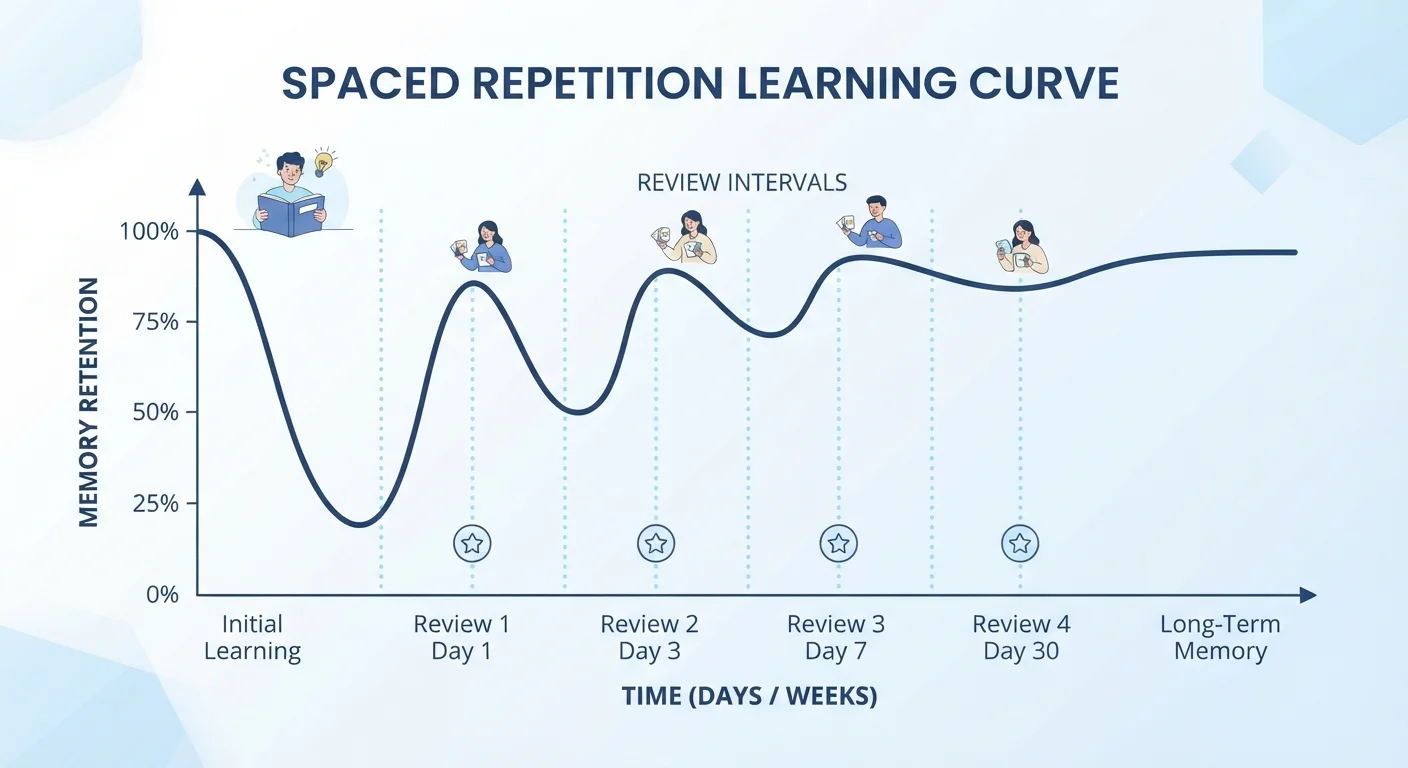
Once your schedule is in place, the method you use inside each study block matters enormously. Spaced repetition - reviewing material at increasing intervals - is among the most research-supported techniques available. See how spaced repetition works for a practical breakdown of the evidence.
Consistency Beats Cramming Every Time
Research in cognitive psychology consistently shows that distributed practice - studying in shorter, regular sessions - produces better long-term retention than marathon cramming. Building a schedule that spreads study across days is not just a time-management strategy; it is a learning strategy. If you find yourself relying on all-nighters before exams, your schedule needs to be rebuilt, not just adjusted.
Adapting Your Schedule as Circumstances Change
A study schedule is a tool, not a contract. Midterms, project deadlines, work schedule changes, and personal demands all shift the landscape throughout a term. The goal is not to protect your original schedule rigidly but to return to it quickly when disruptions occur.
If a particular subject consistently overruns its allotted time, that is data: either your estimate was too low, or the material requires a different approach. Pairing your schedule with stronger study methods - such as the note-taking systems that best fit your learning style - can reduce the time you need per subject without sacrificing depth.
Students weighing whether to study independently or in a structured course format may also benefit from exploring which learning path fits your life, since the right format directly affects how you schedule and pace your work.