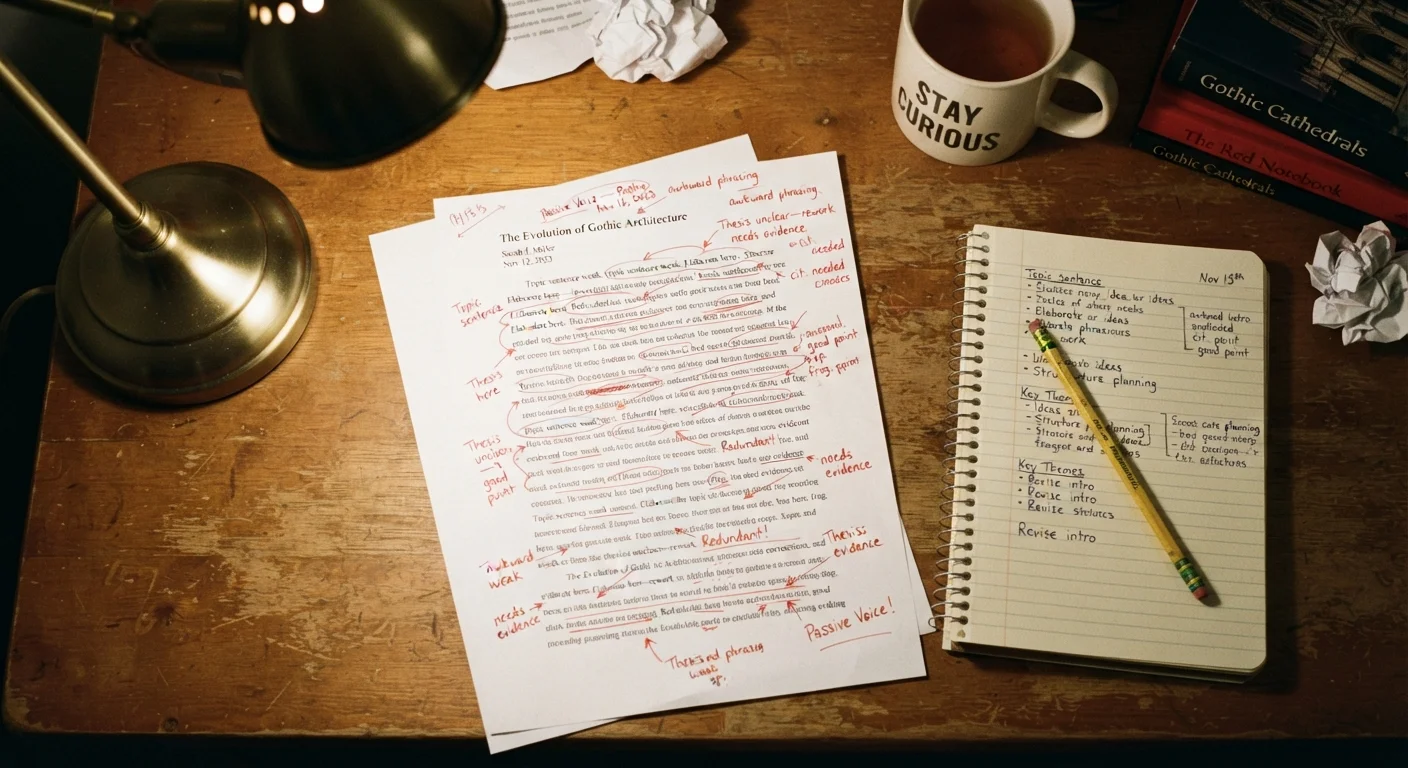

What Makes Academic Writing Different
Academic writing is a specific register - a set of conventions for how ideas are presented, argued, and supported in scholarly contexts. It differs from journalistic, creative, or conversational writing in several consistent ways: it requires a clear argumentative position, relies on credible evidence, uses formal language, and documents sources precisely.
Understanding these expectations early saves students significant frustration. Many students lose marks not because their ideas are weak, but because they haven't yet learned the form in which those ideas need to be expressed. This guide is part of a broader collection of academic skills resources designed to support students at every stage.
Thesis statement
A sentence - usually at the end of the introduction - that states the central argument of your paper. It tells the reader what position you are defending and why it matters.
Topic sentence
The opening sentence of a body paragraph that identifies the single main idea that paragraph will develop. It connects that idea back to the overall thesis.
Citation
A formatted reference that identifies the source of a quote, paraphrase, or idea you've used. Citations protect you from plagiarism and allow readers to locate your sources.
Paraphrase
Restating someone else's idea in your own words and sentence structure. Paraphrased material still requires a citation - changing the wording does not make the idea your own.
Academic register
The level of formality and the set of conventions - word choice, sentence structure, tone - expected in scholarly writing contexts.
Plagiarism
Using another person's words, ideas, or work without proper attribution, whether intentional or accidental. Most institutions treat it as a serious academic integrity violation.
Building a Clear Structure
Nearly every academic essay - regardless of discipline or length - depends on the same underlying skeleton: introduction, body, and conclusion. Each component has a distinct job.
- Introduction: Orients the reader, narrows to your topic, and closes with a thesis statement - the central argument your paper will defend.
- Body paragraphs: Each paragraph focuses on one supporting point, opened with a topic sentence, developed with evidence, and closed with analysis connecting back to the thesis.
- Conclusion: Synthesizes what you've argued without merely repeating it. A strong conclusion reflects on the significance of the argument rather than summarizing mechanically.
The thesis is the engine of the whole structure. For a deeper look at how to construct one, see our guide on thesis statement structure and common pitfalls.
Outline Before You Draft
Before writing a single sentence of prose, spend 10-15 minutes sketching an outline. List your thesis, then note one main point per body paragraph and the evidence you plan to use. This simple step prevents the most common structural problems - wandering arguments and paragraphs with no clear purpose.
Tone, Voice, and Word Choice
Academic tone sits between dry formality and casual conversation. You're not writing a text message, but you're also not trying to impress readers by burying simple ideas in complicated language. The goal is precision and clarity.
Practical guidelines for academic tone:
- Avoid contractions (don't → do not) in most academic contexts.
- Use the first person (I argue, I contend) only when your assignment permits it - some disciplines discourage it.
- Hedge appropriately: write the evidence suggests rather than this proves unless your evidence genuinely supports certainty.
- Choose specific words over vague ones: the study found a 12% increase is stronger than the results were significant.
Watch out for common pitfalls in phrasing. Our related guide covers where students lose points on essay assignments, including vague arguments and weak transitions.
Citation Basics Every Student Needs
Citation serves two purposes: it credits the original thinker, and it lets your reader trace and verify your evidence. Failing to cite - even accidentally - can constitute plagiarism, which carries serious academic consequences.
The three most common US academic citation styles are:
- MLA (Modern Language Association)
- Common in English and humanities courses. Uses in-text author-page citations and a Works Cited page.
- APA (American Psychological Association)
- Standard in social sciences, education, and psychology. Uses author-date in-text citations and a References list.
- Chicago/Turabian
- Frequently used in history and some humanities. Offers footnote/endnote or author-date systems.
Your instructor or assignment sheet will specify which style to use. If it doesn't, ask before you begin. Pairing good citations with strong source evaluation will sharpen your writing further - explore research skills every college student should develop to build that foundation.
Citation Generators Are a Starting Point
Online citation generators can help format references quickly, but they frequently produce errors - especially with unusual source types like government documents, edited volumes, or websites. Always verify generated citations against your style guide's official examples before including them in your paper.
From Draft to Polished Paper
Revision is where writing quality is actually built. A first draft's purpose is to get your ideas on the page - clarity and polish come in subsequent passes. Experienced writers routinely revise multiple times before submitting.
A practical revision sequence:
- Big-picture pass: Does every paragraph serve the thesis? Is the argument in a logical order? Are there gaps in reasoning?
- Paragraph-level pass: Does each paragraph have a clear topic sentence? Is evidence followed by analysis?
- Sentence-level pass: Are sentences clear and varied in length? Have you eliminated unnecessary words?
- Proofreading pass: Check spelling, punctuation, grammar, and citation formatting.
Where possible, read your draft aloud - it surfaces awkward phrasing your eyes tend to skip over. Asking a peer, a writing center tutor, or an instructor for feedback at the draft stage is one of the highest-value steps a student can take. If you're also planning a broader academic improvement effort, setting up a structured learning plan can help you build sustainable writing habits alongside other goals.
Don't Skip the Proofreading Step
Submitting a paper without a dedicated proofreading pass often costs students easy points on otherwise strong work. Spell-check tools miss homophone errors (their/there/they're), missing words, and citation formatting issues. Always read a printed or zoomed-out version of your paper with fresh eyes before submitting.