
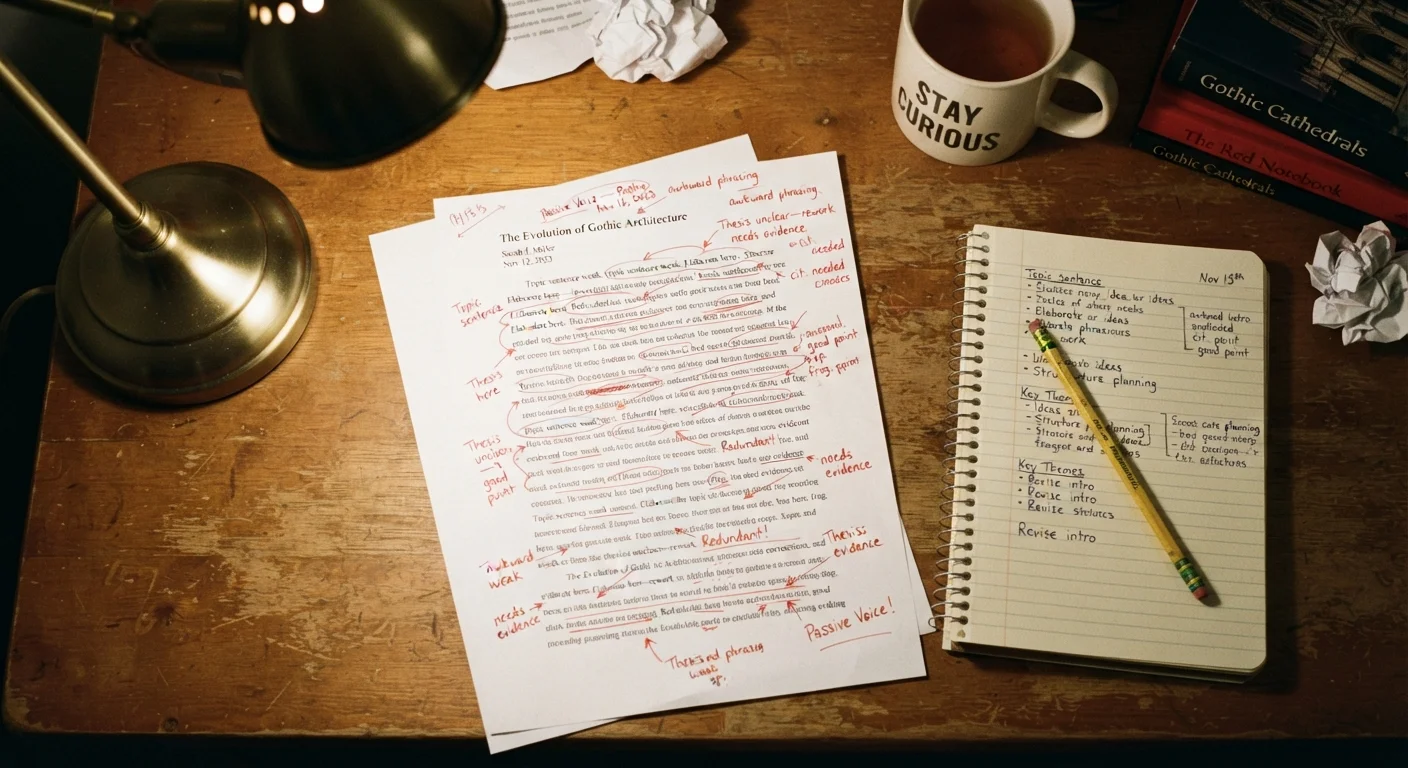
Why the Same Errors Keep Appearing
Essay grading patterns are remarkably consistent across instructors and institutions. Whether you're in a high school English class or an undergraduate seminar, the same clusters of mistakes account for the majority of lost points. Understanding why these errors recur-not just what they are-is the first step toward writing that actually earns better grades.
Most essay problems trace back to three root causes: insufficient planning before writing, treating the first draft as the final draft, and misunderstanding what instructors are actually evaluating. Academic writing fundamentals cover structure and tone, but the errors below go deeper into the recurring patterns that cost students the most points.
Writing a thesis that states a topic rather than an argument.
Why it happens: Students are often taught to 'introduce the subject' in their opening paragraph, which leads to descriptive openers instead of arguable claims.
Dropping quotations into paragraphs without context or explanation.
Why it happens: Students assume a strong quote speaks for itself, so they place it in the paragraph and move on.
Using transitions that signal sequence ('first,' 'next,' 'finally') when the logic requires contrast or causation.
Why it happens: Sequential transitions feel safe and are easy to remember, so students default to them even when paragraphs don't follow a step-by-step order.
Writing a conclusion that simply restates the introduction word for word.
Why it happens: Students run out of time or ideas and recycle their opening paragraph, not realizing conclusions are expected to synthesize, not repeat.
Ignoring the assignment rubric until after the essay is written.
Why it happens: Students focus on writing quickly and treat the rubric as an afterthought rather than a planning document.
How to Apply This in Your Next Draft
Knowing the mistakes is only half the work. The other half is building a revision habit that catches them before submission.
Revision Is Not Optional
A first draft is a thinking tool, not a finished product. Instructors who grade thousands of papers report that the gap between a B and an A often comes down entirely to whether the student revised with intention. Build at least one dedicated revision session into every essay assignment-separate from the initial writing session.
A practical approach: after completing your draft, read it once purely for argument (does every paragraph connect back to your thesis?), then once for evidence (is every source introduced, cited, and explained?), and finally once for transitions and flow. This three-pass method takes less time than rewriting a graded paper.
Summarizing Sources Is Not Analysis
One of the most penalized habits in academic writing is restating what a source says without explaining why it matters to your argument. Instructors look for your interpretation, not a report of someone else's. If your body paragraphs read like a list of summaries, your analysis score will suffer regardless of how accurate the summaries are.
Students who struggle with test performance alongside writing challenges may find it useful to explore managing academic performance anxiety, since similar pressure-avoidance patterns show up in both contexts. For a broader overview of skills that affect academic success, the complete academic skills resource covers everything from time management to writing strategies in one place.
60-70%
Essays penalized for weak thesis statements
Writing center intake data at multiple universities consistently identifies thesis clarity as the leading cause of grade loss on academic essays.
3×
Revision sessions linked to higher grades
Research on self-regulated learning suggests students who revise in multiple passes produce measurably stronger writing than those who revise once before submission.