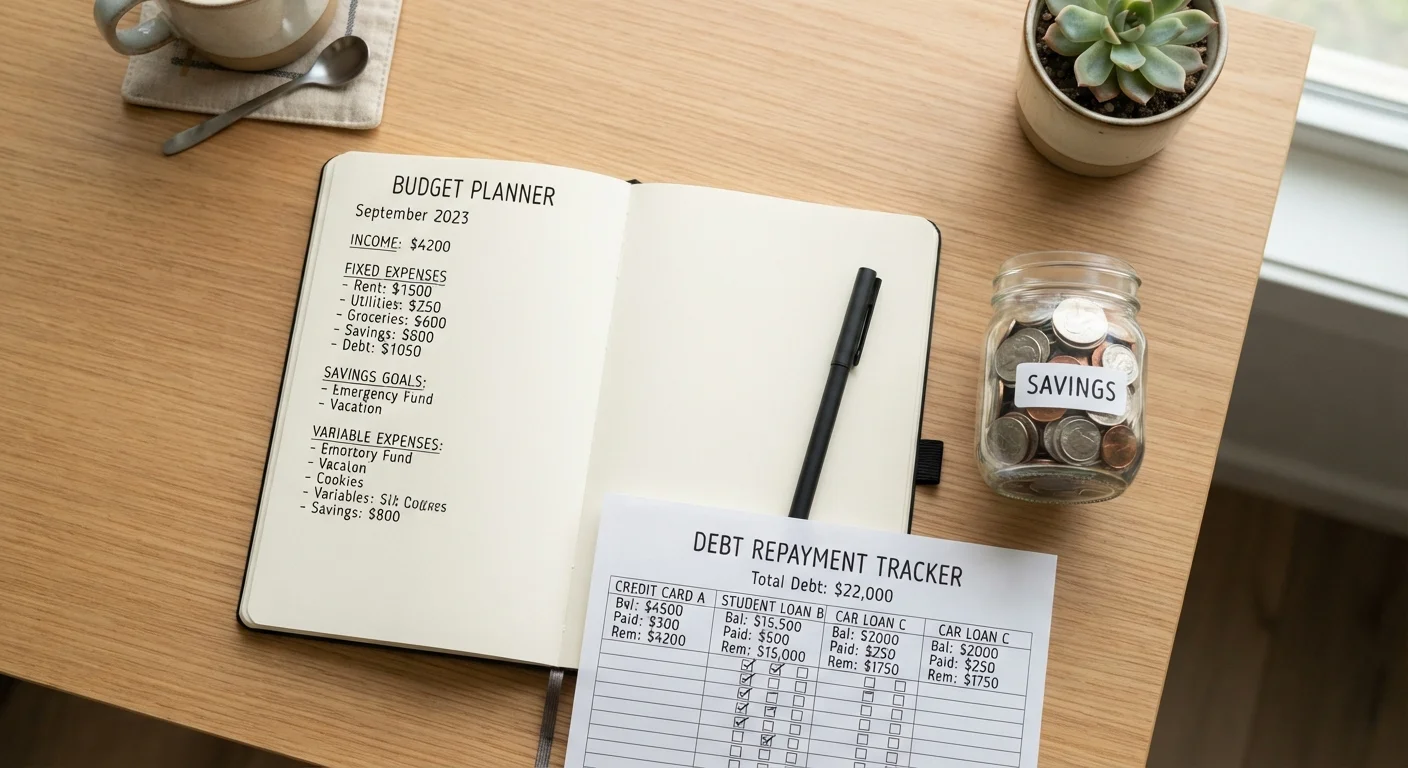

How to Calculate Your Savings Rate
The formula is straightforward:
Savings Rate = (Amount Saved ÷ Income) × 100
For example, if you earn $5,000 per month after taxes and save $600 - including retirement contributions and any extra debt principal - your savings rate is 12%. That single number tells you more about your financial trajectory than your account balance does at any given moment.
What counts as "saved"? Include contributions to retirement accounts (401(k), IRA, Roth IRA), transfers to a dedicated emergency or goal fund, and principal-only payments toward debt. Do not count interest payments, everyday spending, or money parked temporarily in checking.
Use a Rolling Average for Variable Income
If your income varies month to month, calculate your savings rate over a rolling three-month average rather than a single month. This smooths out irregular paychecks and gives a more reliable baseline to work from. Freelancers, contractors, and commission-based workers especially benefit from this approach.
If your income varies month to month, calculate your savings rate over a rolling three-month average rather than a single month. This smooths out irregular paychecks and gives a more reliable baseline to work from.
What Your Savings Rate Actually Tells You
Your savings rate is a ratio, not a fixed dollar amount - which makes it one of the most honest measures of financial progress. A household earning $40,000 and saving 20% is building wealth more deliberately than one earning $120,000 and saving 5%, even though the dollar difference looks dramatic.
4.6%
US personal savings rate (2023 annual average)
According to the U.S. Bureau of Economic Analysis, the personal saving rate - savings as a percentage of disposable income - averaged around 4.6% in 2023, well below the 15-20% range commonly recommended by financial planners.
15-20%
Recommended savings rate for long-term goals
Most established financial guidance, including guidance from FINRA and many certified financial planners, suggests saving 15-20% of gross income to remain on track for a secure retirement and adequate emergency reserves.
56%
Americans unable to cover a $1,000 emergency
A Bankrate survey found that more than half of U.S. adults could not cover an unexpected $1,000 expense from savings alone, underscoring how directly savings rate connects to near-term financial resilience.
The rate also reveals how much runway you have. A 20% savings rate means that for every five years you work, you effectively bank one year of living expenses. At 10%, it takes ten years to save one year of expenses. These aren't predictions - they're simply ratios that illustrate the leverage your savings rate creates over time.
Understanding where you stand also helps you make smarter trade-offs. If you're weighing whether to pay down debt aggressively versus growing an emergency fund, your savings rate gives you a baseline to stress-test both scenarios. See our guide on paying off debt and saving at the same time for a realistic framework for splitting limited income.
Realistic Targets and How to Improve Your Rate
There's no universally "correct" savings rate, but common benchmarks offer a useful starting point:
- Under 10%: Building a foundation - focus on eliminating high-cost debt and establishing an emergency fund before pushing this number higher.
- 10%-15%: Functional range for many households - adequate for gradual wealth-building, though retirement timelines may be extended.
- 15%-20%+: Generally considered healthy for long-term goals, including a comfortable retirement timeline for workers starting in their 20s or 30s.
Improving your rate comes down to two levers: spend less or earn more. Both are valid. Trimming recurring subscriptions, renegotiating fixed costs, and being deliberate about daily spending habits can create meaningful margin without radical lifestyle changes. Simultaneously, directing any income increases - raises, bonuses, side income - straight to savings before lifestyle inflation sets in is one of the most reliable ways to move the needle.
Where you keep your savings also matters at the margin. If you're holding emergency funds in a low-interest account, you may be leaving accessible growth on the table. Understanding the difference between account types - covered in our high-yield vs. traditional savings account comparison - can help you optimize where your saved dollars sit.
This article is for general informational purposes only and does not constitute personalized financial advice. Consult a qualified financial professional for guidance tailored to your specific situation.