Why Doing Both at Once Makes Sense
The conventional advice - pay off every dollar of debt before saving a cent - sounds disciplined, but it creates a practical problem: life doesn't pause during your payoff period. An unexpected car repair or medical bill without any cash reserve often means adding new debt, erasing months of progress. Saving nothing while attacking debt leaves you financially exposed.
The smarter approach treats debt reduction and savings as parallel tracks rather than a sequential race. You allocate a defined portion of income to each, adjust the ratio based on interest rates and urgency, and keep both moving forward. Progress may be slower on each front individually, but your overall financial position strengthens instead of oscillating.
This article is general financial information, not personalized financial advice. For guidance specific to your situation, consider consulting a licensed financial professional.
Step One: Know Your Numbers
Before splitting dollars between goals, you need a clear baseline. Pull together three figures:
- Monthly take-home income: what actually lands in your account after taxes and deductions.
- Fixed monthly obligations: rent or mortgage, minimum debt payments, insurance, utilities.
- True discretionary income: what remains after fixed obligations - this is your working budget for extra debt payments and savings contributions.
Many people skip this step and operate on intuition, which makes consistent allocation nearly impossible. Spending even 20 minutes mapping these numbers in a spreadsheet - or using a budgeting app - gives you a factual foundation rather than guesswork. See the budgeting basics hub for straightforward frameworks to structure this exercise.
77%
Americans carrying some form of debt
According to Federal Reserve surveys, a large majority of U.S. households carry at least one form of debt, underscoring why a dual-track strategy is relevant to most households.
~20%+
Average credit card interest rate (APR)
Federal Reserve data has shown average credit card rates have remained well above 19-20% in recent periods, making high-rate debt reduction a high-priority financial move.
$500
Minimum starter emergency fund target
Financial educators commonly recommend a $500-$1,000 cash buffer as an initial emergency fund goal before directing extra dollars to debt repayment.
How to Split Your Dollars: A Practical Framework
Once you know your discretionary income, the allocation decision becomes a rate-of-return comparison. Think of it this way: paying down a debt charging 22% APR delivers a guaranteed 22% return on that dollar. Saving the same dollar in an account earning 4-5% yields far less. Interest rate arithmetic generally points toward directing more toward high-interest debt.
A workable starting split for most situations:
- Build a starter emergency fund first - typically $500-$1,000 - before directing any extra dollars to debt. This cushion prevents a single unexpected expense from derailing everything. See our guide on building an emergency fund while carrying debt for a deeper look at this balance.
- Capture any employer retirement match - if your employer matches 401(k) contributions up to a percentage, contribute enough to capture that match before making extra debt payments. Walking away from a match is effectively leaving compensation on the table.
- Direct the remainder by interest rate - allocate the bulk of remaining discretionary dollars toward your highest-interest debt. Once that balance is cleared, redirect those freed-up dollars to the next priority.
High-Interest Debt Changes the Math Significantly
When carrying credit card debt or other balances above roughly 15% APR, directing extra savings dollars toward that debt almost always delivers a better financial outcome than building savings beyond a basic emergency cushion. The guaranteed cost of high-interest debt typically exceeds the return available on liquid savings accounts. Prioritize eliminating high-rate balances before expanding savings goals beyond the essentials.
Ratios will vary. Someone with a 7% student loan and a solid emergency fund can reasonably split extra dollars between debt and a longer-term savings goal. Someone carrying 24% credit card balances should weight heavily toward debt elimination. There's no universal percentage - the rate differential is your guide.
Choosing Your Debt Payoff Strategy
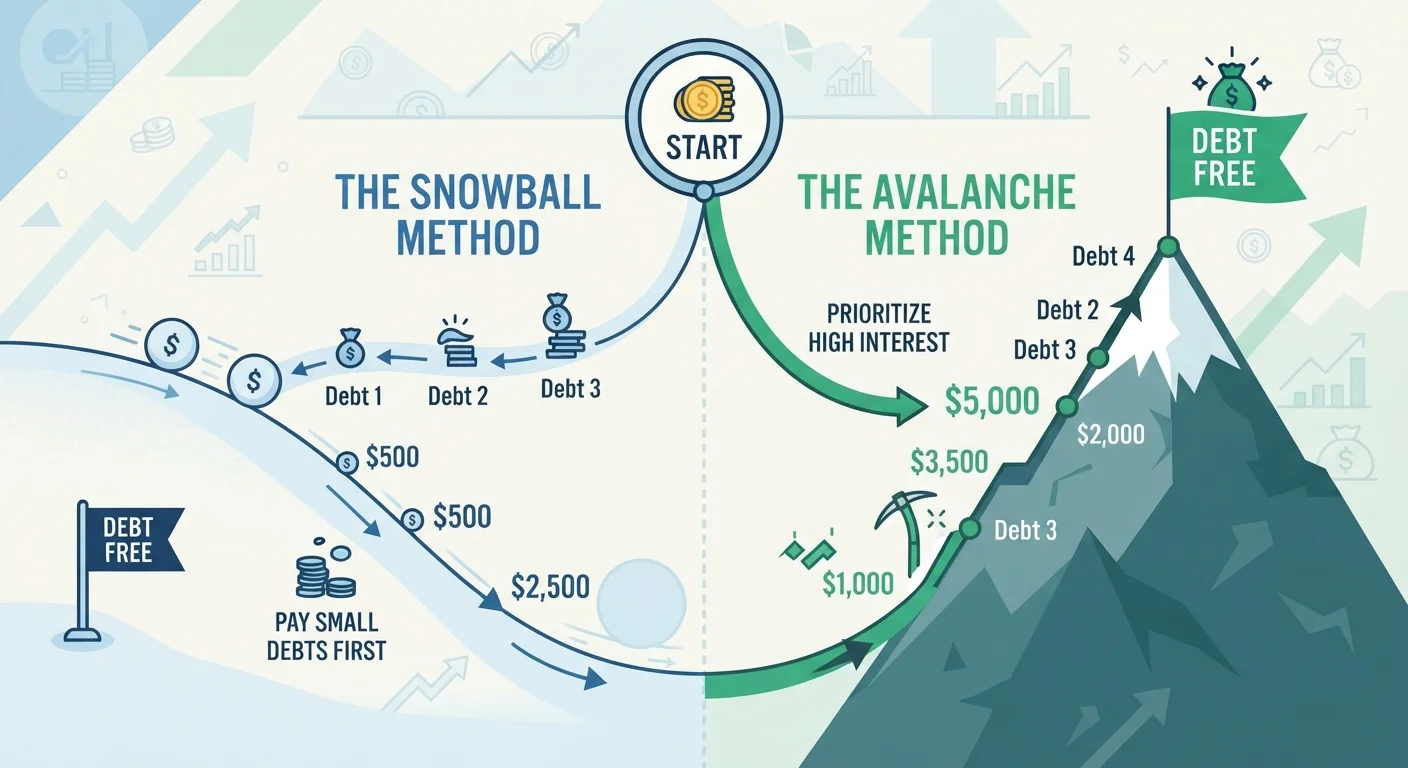
Two widely used methods structure how you sequence multiple debts:
- Debt avalanche: Pay minimums on all debts; direct extra dollars to the highest-interest balance first. Mathematically, this minimizes total interest paid.
- Debt snowball: Pay minimums on all debts; direct extra dollars to the smallest balance first. Each eliminated account creates a motivational win that can sustain momentum.
Research on behavior and debt repayment suggests consistency matters as much as mathematical optimality - a plan you actually stick with outperforms an optimal plan you abandon. Our detailed breakdown of the avalanche vs. snowball methods can help you decide which fits your personality and situation.
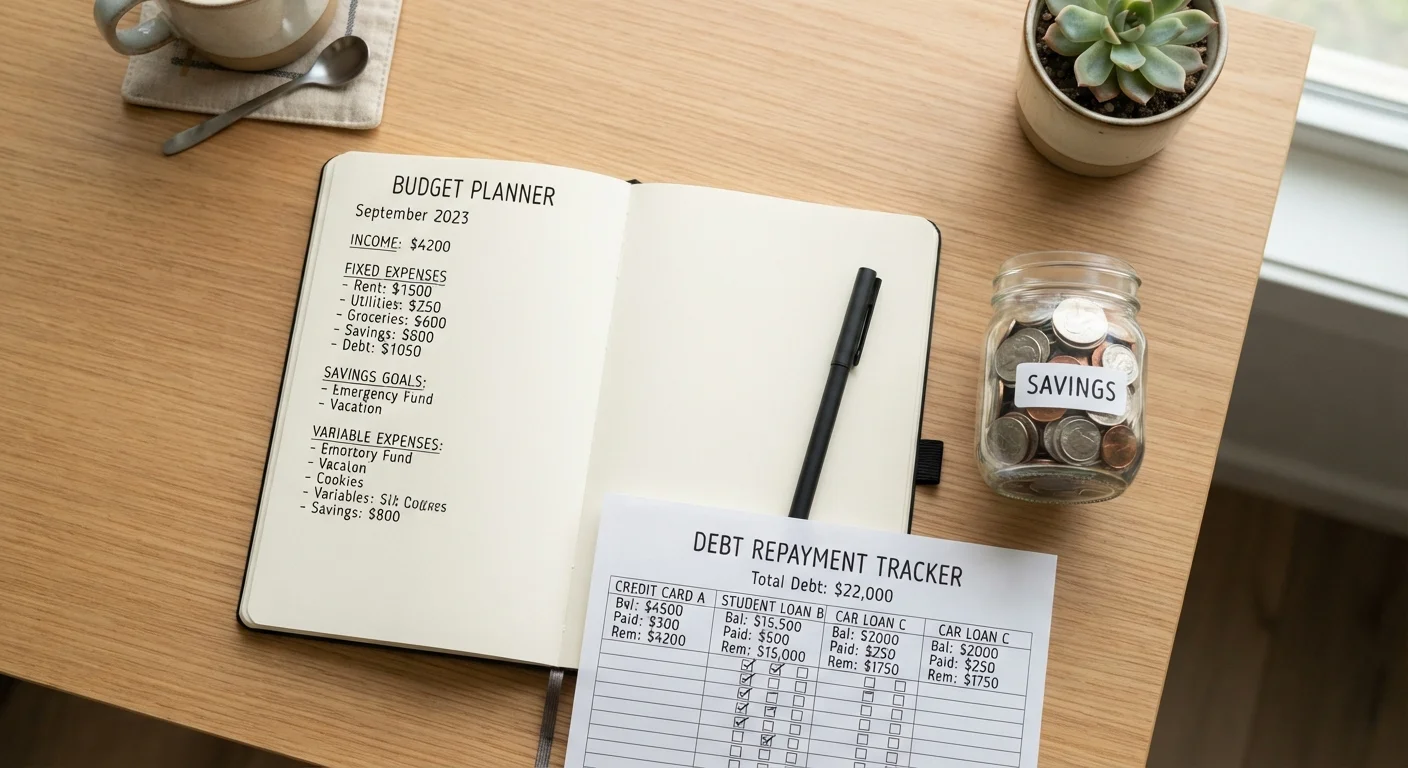
Before choosing avalanche or snowball, list every debt with its balance, rate, and minimum payment side by side. Seeing the full picture in one place often makes the right starting priority obvious.
Debt payoff decisions made without a complete inventory frequently miss the account with the highest actual cost, slowing overall progress.
When a debt balance is cleared, immediately redirect that payment amount to the next target rather than absorbing it into discretionary spending - this 'payment stacking' dramatically accelerates timelines.
Freed cash flow from a paid-off account is the most powerful accelerant in a debt payoff plan; letting it dissolve into spending is the most common way people slow their own momentum.
If managing multiple accounts feels overwhelming, debt consolidation is worth understanding - it can simplify repayment, though it comes with trade-offs to evaluate carefully.
Which Savings Goals to Prioritize First
Not all savings goals carry equal urgency. A useful hierarchy while carrying debt:
- Emergency fund - starter amount first, then build toward one to three months of essential expenses over time.
- Employer-matched retirement contributions - capture the full match before anything else in long-term savings.
- Sinking funds for known upcoming expenses - car registration, annual insurance premiums, holiday spending. Setting aside small monthly amounts prevents these predictable costs from becoming debt. Learn how sinking funds work as a debt-prevention tool.
- Additional retirement or longer-term savings - after high-interest debt is cleared, redirect freed cash flow here.
Where you keep savings also matters. High-yield savings accounts typically offer meaningfully higher interest than standard accounts, which matters more when you're carrying debt and every dollar needs to work efficiently.
Open a Separate Account for Each Goal
Keeping emergency fund savings and sinking fund money in separate labeled accounts - even at the same institution - reduces the temptation to raid one goal to fund another. Many online banks allow multiple savings buckets with individual nicknames, making it easier to see exactly where each dollar stands.
Making Progress Stick Over Time
The framework only works if it runs consistently. Two habits reinforce that:
Automate transfers immediately after payday. Schedule your savings deposit and extra debt payment to move the day your paycheck arrives - not whatever is left at month's end. The power of automated transfers is that they make disciplined behavior the default rather than a daily willpower decision.
Run a monthly reset. Spend 15-20 minutes each month reviewing balances, checking that allocations still reflect your situation, and adjusting if income or expenses have changed. A structured monthly checklist makes this review systematic rather than ad hoc.
Be alert to habits that quietly undermine debt payoff plans - small behavioral patterns that erode progress without feeling significant in the moment.
Finally, tracking your savings rate over time provides a clear signal of whether your dual-track approach is working. A rising savings rate alongside falling debt balances tells you the framework is functioning.
This article is for general informational and educational purposes only and does not constitute personalized financial, investment, tax, or legal advice. Consult a qualified financial professional before making decisions about your specific circumstances.