
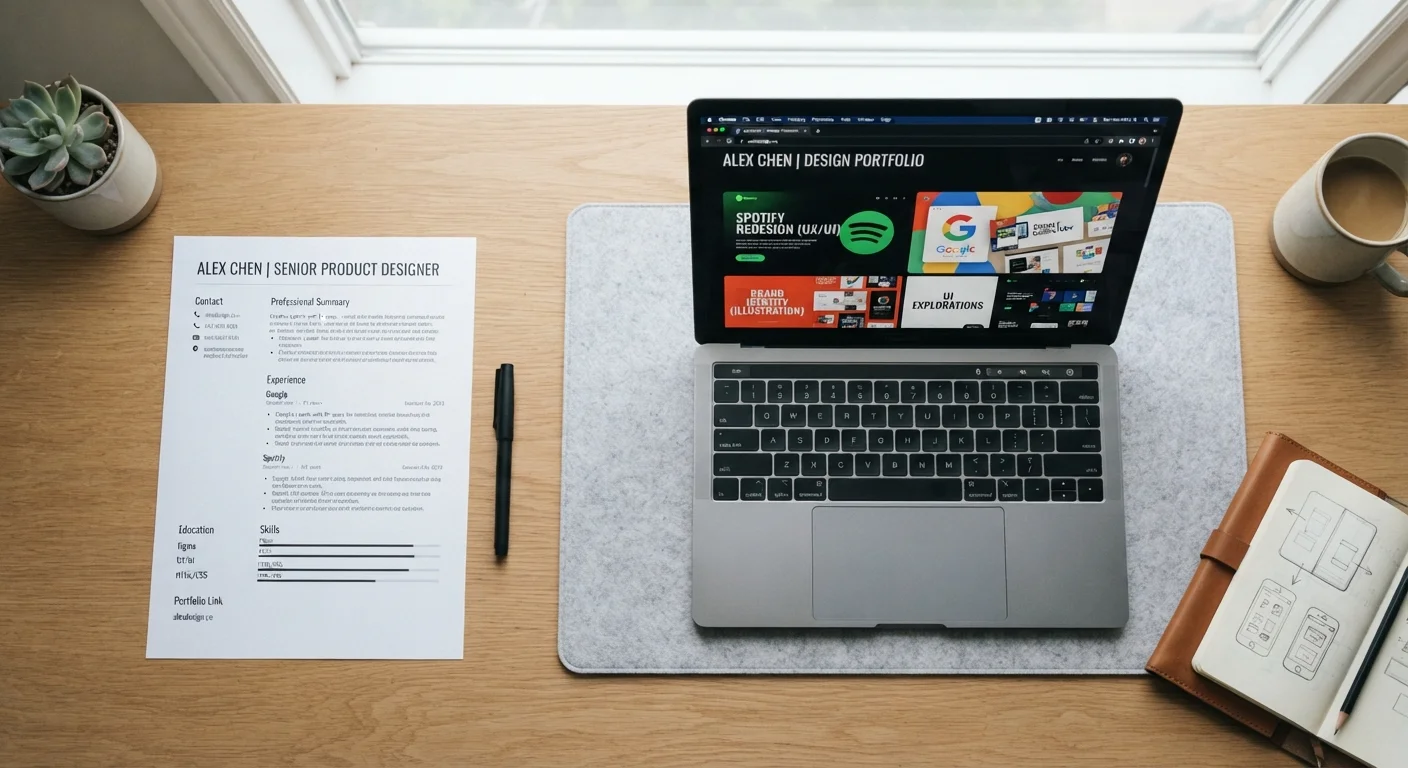
What Each Document Is Actually Doing
A résumé is a structured summary: job titles, employers, dates, responsibilities, and credentials arranged to signal fit at a glance. Its job is to pass initial screening - often automated - by matching keywords and demonstrating a recognizable career trajectory. It answers the question where have you been?
A portfolio, by contrast, answers what can you actually produce? It presents artifacts of work - writing samples, design files, code repositories, case studies, photographs, or project documentation - allowing an evaluator to assess quality and process directly, rather than infer them from job titles.
Both documents are filters, but they filter for different things. A résumé filters on credentials and history; a portfolio filters on demonstrated capability. Understanding that distinction helps you decide which deserves more of your preparation time for a given opportunity. See also how employers weigh credentials more broadly in our overview of microcredentials, certificates, and degrees.
When the Portfolio Carries More Weight
Certain fields have structurally shifted toward portfolio-first evaluation because output quality is less ambiguous than job titles suggest. These include:
- Graphic design, UX/UI, and visual arts - a candidate who can show polished, user-tested work has a clear advantage over one who lists "proficient in design tools."
- Software development and data science - public code repositories, personal projects, and documented problem-solving replace lengthy credential debates.
- Copywriting, journalism, and content strategy - published clips or a writing portfolio signal voice, accuracy, and range far better than an employment list.
- Architecture, interior design, and photography - work speaks visually in ways words cannot replicate.
- Career changers at any level - when job titles in a new field are absent, demonstrated project work bridges the gap credibly.
| Portfolio | Résumé | |
|---|---|---|
| Primary question answered | What can you produce? | Where have you been? |
| Best suited for | Creative, technical, project-based roles | Regulated, credential-heavy, management roles |
| Career changers | Strong - shows new skills without titles | Weak - gaps and unfamiliar titles raise doubts |
| ATS compatibility | Not parsed by most ATS systems | Designed to pass ATS screening |
| Preparation effort | High - requires curation and context | Moderate - structured format is familiar |
| Longevity between updates | Requires regular refresh | Updated per application |
If you are navigating a career pivot, understanding how to decode role requirements first is critical - our article on reading a job description as a learning roadmap walks through that process step by step.
When the Résumé Remains the Standard
Not every hiring process places equal weight on demonstrated output. In regulated or credential-dependent fields - healthcare administration, law, finance, government, and higher education - specific degrees, licenses, or certifications are threshold requirements. No portfolio substitutes for a required license number or a listed institution.
Similarly, in roles where scope of responsibility matters more than individual output - management, operations, policy - reviewers look for evidence of scale: budget size, team counts, and organizational context. These translate naturally into résumé language and poorly into a visual or project portfolio.
Corporate applicant tracking systems (ATS) are also built around résumé parsing. A portfolio URL in a submission may never be clicked if the structured résumé data does not pass automated screening first. In that context, a résumé is not optional - it is the price of entry.
Lead With the Résumé, Follow With the Portfolio
For most applications, the practical approach is to use your résumé to clear initial screening and include a portfolio link prominently - in the contact header or a brief note in your summary section. This respects ATS requirements while giving interested reviewers an immediate path to your work. In fields where portfolio review is the norm, confirm the submission format before defaulting to either document alone.
Building a Portfolio That Actually Works
A portfolio that dumps uncontextualized files into a folder is no stronger than a résumé that lists duties without impact. Effective portfolios share several qualities:
- Curate, don't accumulate. Five strong pieces outperform twenty uneven ones. Select work that represents the level you are targeting, not everything you have ever done.
- Add process context. Brief case-study notes explaining the problem, your approach, and the outcome transform a sample into evidence of thinking, not just execution.
- Make it accessible. A PDF with clear file names, a simple personal site, or a platform appropriate to your field removes friction for a busy reviewer.
- Keep it current. Stale work signals stagnation. Update it as skills grow.
Note that strong portfolios often surface the same interpersonal and cognitive strengths that employers value beyond technical skill. Our piece on professional competencies that move careers forward covers how those qualities complement demonstrated output.
70%+
Large employers using ATS to screen résumés
Research by recruiting platform Jobscan has consistently found that the majority of Fortune 500 companies use applicant tracking systems as an initial filter, making a parseable résumé a baseline requirement even in portfolio-forward fields.
~6 sec
Average initial résumé review time
Eye-tracking studies cited in hiring research suggest recruiters spend roughly six seconds on an initial résumé scan, underscoring the importance of clear, scannable structure over dense prose.