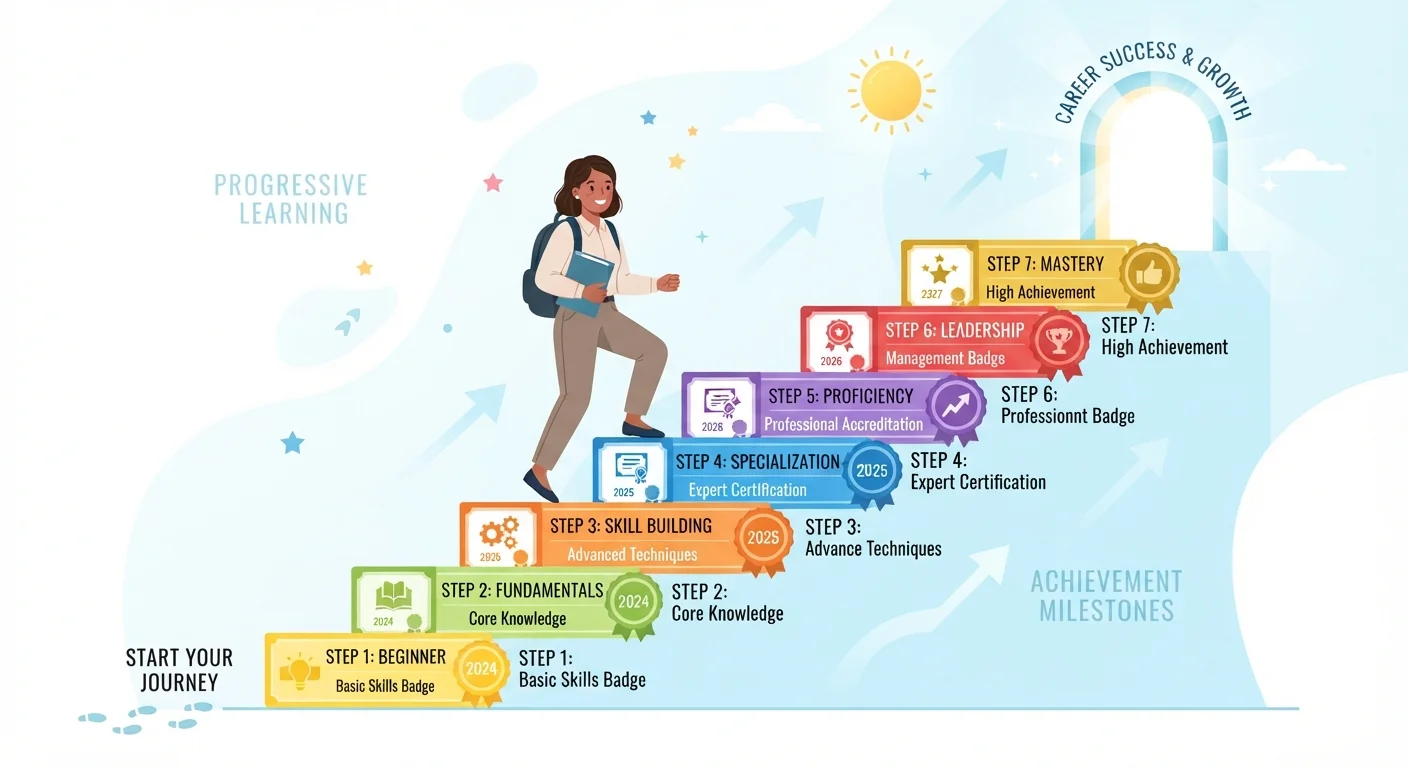

Three Types of Credentials, Three Different Signals
When a hiring manager scans a résumé, each credential type triggers a different set of assumptions. Understanding what each one communicates - and where that communication breaks down - is the starting point for making smarter learning investments.
Degrees (associate, bachelor's, master's, doctoral) signal extended academic commitment, exposure to broad foundational knowledge, and the ability to complete long-term structured programs. They are still the default expectation in many professional fields and are frequently used as a first-pass filter by applicant tracking systems.
Certificates and certifications occupy a middle ground. A certificate documents that you completed a course or program. A certification - issued by a professional or industry body after an assessment - signals that an independent authority has verified your competence to a defined standard. The latter generally carries substantially more hiring weight because it involves external accountability.
Microcredentials are short, focused learning achievements - digital badges, nano-degrees, or course completion records from online platforms. They signal specific, current skill exposure, but their credibility depends heavily on who issued them and whether an employer recognizes that issuer. They function best as a complement to other credentials rather than a standalone qualification in most hiring contexts.
62%
Employers who value industry certifications highly
According to a CompTIA survey, a significant majority of HR and hiring managers report that industry certifications are valuable or very valuable when evaluating candidates for IT roles.
70%+
Large employers that have dropped degree requirements for some roles
Research from Burning Glass Institute (now Lightcast) found that a growing share of major US employers removed bachelor's degree requirements from a portion of job postings between 2017 and 2022, though the trend varies significantly by occupation.
1 in 5
US workers holding an industry credential or license
The Bureau of Labor Statistics reports that roughly one in five US workers holds some form of occupational license or industry credential, underscoring their role in regulated and trade sectors.
How Industry and Role Shape Employer Expectations
There is no single universal answer to which credential wins. Employer expectations are shaped by sector norms, company culture, and the functional demands of each role.
In regulated professions - nursing, engineering, accounting, law - credentials are not optional. Specific degrees and licensure requirements are set by law or professional bodies, and alternatives are not recognized regardless of demonstrated skill.
In technology and software development, employers have shifted considerably over the past decade. Many large technology employers have publicly removed degree requirements for certain roles, placing greater emphasis on demonstrated ability through portfolios, technical assessments, and relevant certifications from recognized bodies (such as AWS, Google, or CompTIA). That said, degree holders still dominate hiring pipelines at many organizations.
In business and management, a degree - particularly at the graduate level - continues to signal leadership readiness for many employers. Industry certifications such as the Project Management Professional (PMP) add specific operational credibility alongside a degree, but rarely substitute for one at the hiring stage.
In creative and trade fields, demonstrated work often outweighs formal credentials altogether. A portfolio of results can speak louder than institutional paperwork. For context on when showing work matters more than listing it, see when a portfolio outperforms a résumé.
“Credentials are most powerful when they correspond to skills an employer can verify - either through assessment, demonstrated work, or both. A piece of paper matters most when it stands for something the employer already understands.”
— Anthony P. Carnevale, Director, Georgetown University Center on Education and the Workforce
Why Microcredentials Work Better as Supplements
Microcredentials have expanded access to skill-building in genuinely useful ways, but adult learners sometimes invest significant time in them expecting career-level returns that don't materialize. The core issue is that most employers currently lack frameworks for consistently evaluating them.
Where microcredentials add clear value is in specific scenarios: demonstrating that you've updated a skill in a fast-moving area, filling a visible gap on a résumé before a role transition, or showing initiative and continuous learning within a current job. They are most credible when issued by a major university extension program, an established technology vendor, or a recognized professional association.
Match the Credential to the Employer's Language
Before pursuing any credential, search recent job postings for roles you want and note exactly how employers describe the qualifications they seek. If a specific certification name appears repeatedly, that's meaningful signal. If a credential you're considering doesn't appear in those postings at all, consider whether a different credential - or a portfolio of work - might speak more directly to hiring managers in that field.
One practical approach is to treat microcredentials as part of a sequenced strategy. Stackable credentials allow learners to accumulate recognized achievements over time in a way that adds up to a coherent professional narrative - something a single microcredential course alone rarely achieves.
If you are unsure whether a credential is being received the way you intend, reading job descriptions as a learning roadmap can reveal which qualifications employers in your target field are actually requesting.
Making an Informed Decision About Where to Invest
Choosing where to spend your learning time and money deserves the same analytical attention you would give any significant investment. A few practical principles can guide that decision.
Start with the job market, not the course catalog. Review postings for roles you want to move into and note which credentials appear consistently. Employers tell you exactly what they value if you read carefully.
Verify issuer credibility before enrolling. Ask whether the issuing body is accredited, whether the credential is recognized by employers in your specific target sector, and whether it requires renewal - signs of ongoing professional standards. Resources on evaluating online learning platforms can help you assess provider quality before committing time.
Recognize that credentials are one signal among several. References, demonstrated project work, professional networks, and the ability to articulate what you know in interviews all operate alongside credentials. Learners who treat a certificate as a career-advancement shortcut without developing the underlying skill often find the return disappointing - a pattern explored in depth in the context of where professional development goes wrong.
Credential choices exist on a spectrum. Understanding where each type sits on that spectrum - and how it reads in your specific target field - puts you in a much stronger position to make learning investments that actually move your career forward.
Accreditation Matters for Degree Programs
When evaluating degree programs, regional accreditation (granted by bodies recognized by the US Department of Education) is widely considered the standard marker of institutional quality. Employers, graduate schools, and licensing boards typically require degrees from regionally accredited institutions. National accreditation applies to many vocational schools and online providers but is not universally recognized in the same way. Always verify a program's accreditation status before enrolling.