How Each Card Actually Works
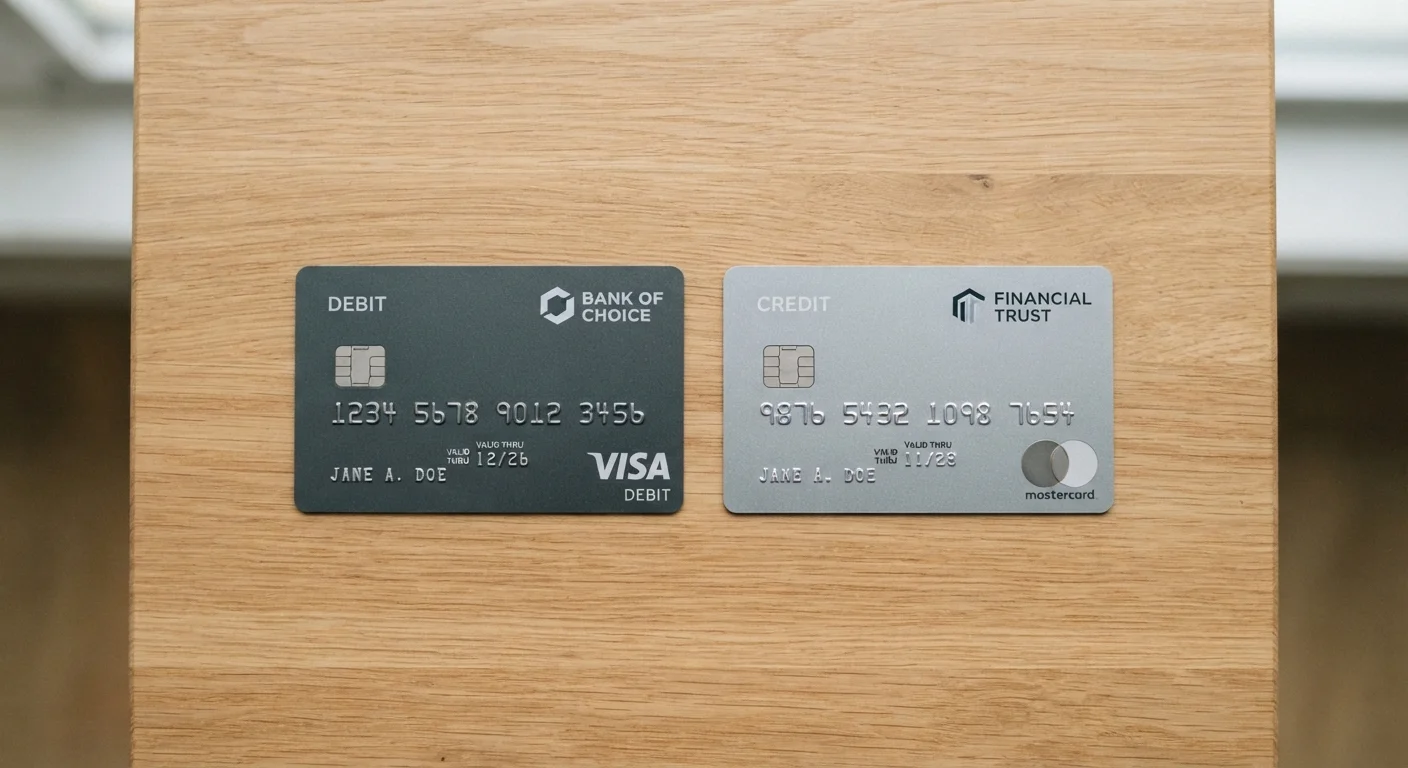
A debit card draws funds directly from your linked checking account at the moment of purchase. If your account holds $400, that's your spending ceiling - no exceptions. A credit card extends a line of credit from an issuer. You spend now and repay later, with interest accruing on any unpaid balance after the billing cycle closes.
That structural difference drives almost every trade-off discussed below. For foundational context on how your checking account integrates with debit spending, see Checking vs. Savings Accounts.
| Criterion | Debit Card | Credit Card |
|---|---|---|
| Spending limit | Capped at account balance | Up to credit limit |
| Fraud liability | Up to $500+ if delayed report | Capped at $50 (often $0) |
| Interest risk | None | High if balance carried |
| Rewards potential | Minimal or none | Cash back, points, miles |
| Impact on credit score | None | Builds credit history |
| Overdraft risk | Yes, if opted into overdraft | No |
| Best habit profile | Budget-conscious spenders | Full-balance payers |
Fraud Protection: A Clear Difference
This is where credit cards hold a meaningful advantage. Under the Fair Credit Billing Act (FCBA), your liability for unauthorized credit card charges is capped at $50 - and most major issuers enforce a zero-liability policy in practice. Critically, disputed charges are resolved while the money stays with you.
Debit cards are governed by the Electronic Fund Transfer Act (EFTA). Liability limits depend on how quickly you report the fraud: within two business days, liability is capped at $50; after that, it can rise to $500 or more. More importantly, fraudulent debit charges draw real money out of your account immediately, which can cascade into overdraft fees or disrupted bill payments while the bank investigates.
Debit Holds Can Tie Up Your Funds
Some merchants - gas stations, hotels, car rental agencies - place temporary authorization holds on debit cards that can exceed the actual purchase amount. These holds can restrict access to your checking account funds for one to several days. Credit cards absorb the same holds without affecting your liquid cash, which is a practical advantage for travelers or anyone with a tightly managed checking balance.
For everyday purchases where fraud risk is higher - online shopping, travel bookings, unfamiliar merchants - a credit card provides a meaningful financial buffer that a debit card simply doesn't match.
Spending Control and Financial Habits
The psychological dimension matters. Debit cards create a hard boundary: no balance, no purchase. Research in behavioral economics consistently suggests that paying with money that leaves your account immediately tends to produce more deliberate spending decisions than paying with credit.
Credit cards can quietly enable spending drift - small charges accumulate across a month, and the bill arrives as a lump sum that's easy to underestimate. If you've noticed this pattern in your own finances, tracking every purchase in a spending journal can recalibrate awareness regardless of which card type you use.
That said, disciplined credit card users who pay their full statement balance monthly don't incur interest and may actually benefit from the consolidated monthly statement as a built-in spending record. The card isn't the problem - the habit is. For a broader look at how daily spending patterns add up, The Truth About Small Daily Expenses is worth reading.
20%+
Average U.S. credit card APR
Federal Reserve data shows average credit card interest rates have surpassed 20% APR, making carried balances costly.
2 days
Debit fraud reporting window for $50 liability cap
Under the Electronic Fund Transfer Act, reporting unauthorized debit card use within two business days limits liability to $50.
$0
Liability under most credit card zero-liability policies
Most major credit card issuers voluntarily extend zero-liability protection beyond the federal $50 minimum for unauthorized charges.
Rewards, Costs, and the Interest Trap
Credit cards often offer cash back, points, or travel rewards on everyday spending categories like groceries and gas. These can represent real dollar value - but only if you pay your balance in full each month. The average credit card interest rate in the U.S. has exceeded 20% APR in recent years, according to Federal Reserve data. A single month of carrying a balance on a rewards card will typically negate weeks of accumulated rewards.
Debit cards rarely offer meaningful rewards programs. You won't earn points at the checkout line, but you also won't pay interest - ever. For anyone managing existing debt, prioritizing payoff over rewards is almost always the better financial move. If you're carrying balances, understanding debt payoff strategies is a logical next step before leaning into credit card spending.
This article provides general financial information and is not a substitute for personalized advice from a licensed financial professional. Individual circumstances vary significantly.