
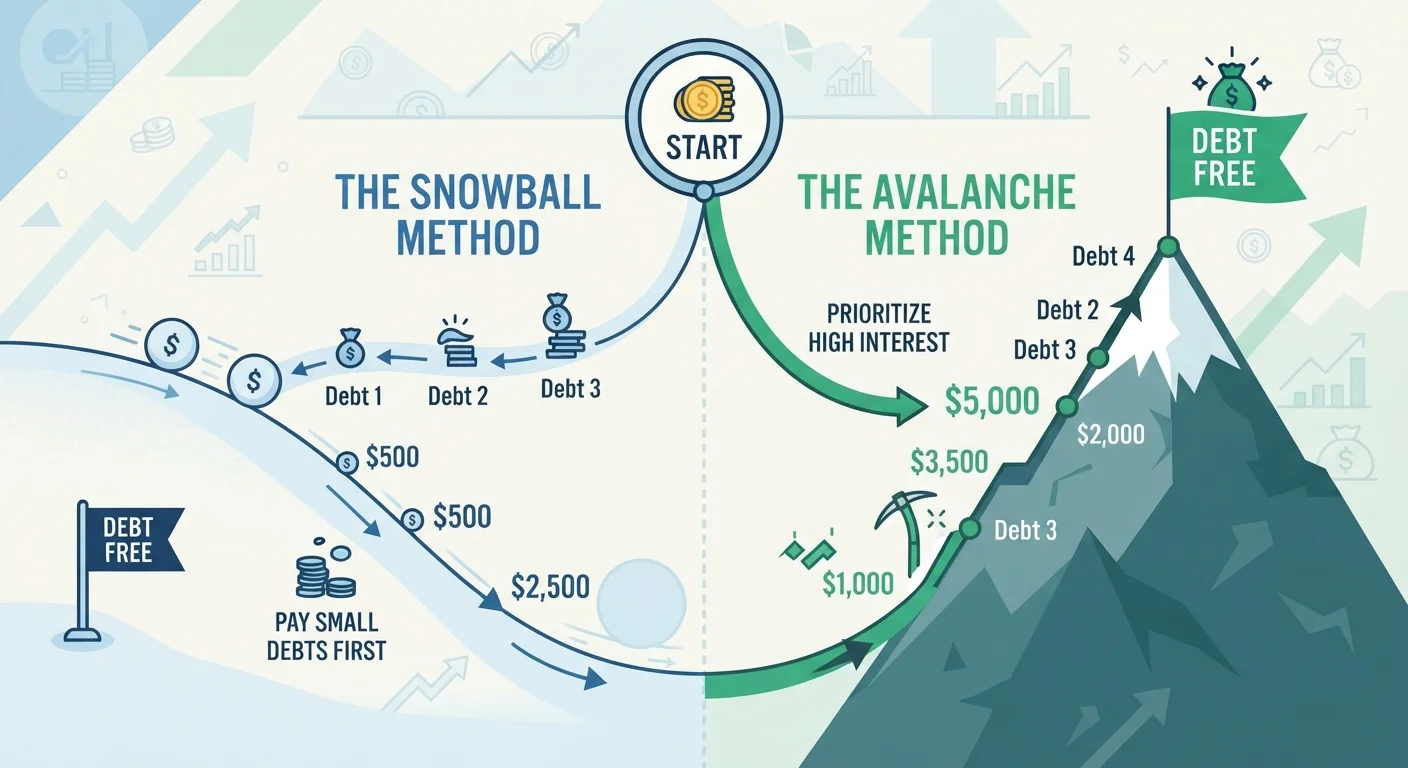
How Each Method Actually Works
Both strategies share the same core mechanic: you pay the minimum on every debt except one, then direct every extra dollar toward that single target. What differs is which debt you prioritize.
Debt Avalanche: List your debts from highest interest rate to lowest. Put extra payments toward the top of that list. Once the highest-rate debt is gone, roll that freed-up payment amount onto the next highest rate. You pay less interest in total, but it may take longer before any single debt disappears from your list.
Debt Snowball: List your debts from smallest balance to largest, regardless of interest rate. Attack the smallest balance first. Once it's eliminated, add its monthly payment to what you're paying on the next smallest. Balances start disappearing quickly, and each elimination reinforces the habit.
In both cases, the power comes from rolling over freed payments rather than spending them elsewhere. Neither method requires earning more money - they simply reorder where your existing dollars go. For a deeper look at structuring limited income across competing financial goals, see this framework for paying off debt and saving simultaneously.
| Criterion | Debt Avalanche | Debt Snowball |
|---|---|---|
| Payoff order | Highest interest rate first | Smallest balance first |
| Total interest paid | Lower (mathematically optimal) | Potentially higher |
| Time to first payoff | Longer (if high-rate debt is large) | Faster (small balances clear quickly) |
| Motivational structure | Abstract savings over time | Frequent, tangible wins |
| Best debt profile | Wide spread in interest rates | Many small or similar-rate debts |
| Behavioral research support | Mathematically superior | Stronger completion rates in studies |
| Complexity | Low (rate comparison needed) | Very low (sort by balance) |
The Real Cost Difference Between the Two
The avalanche method's mathematical advantage is real but varies widely depending on your specific debt mix. If your debts carry similar interest rates - say, two cards at 19% and 21% - the difference in total interest paid between the two methods is often modest. But when one debt carries a significantly higher rate, such as a payday loan or a store card at 28% while other debts sit at 15%, targeting that outlier first can produce meaningful savings.
~$1,000+
Potential interest savings with avalanche on high-rate debt mix
Illustrative estimate based on common debt scenarios; actual savings depend on balances, rates, and payment amounts.
15-29%
Typical credit card APR range in the US
According to Federal Reserve data, average credit card interest rates have risen significantly in recent years, making payoff strategy more consequential.
Higher
Debt elimination rate for account-focused repayers
Research published in the Journal of Marketing Research found that focusing on paying off individual accounts improved overall debt elimination outcomes.
There's also a time dimension. With the snowball, you eliminate individual accounts faster, which some people find reduces financial anxiety and improves budget clarity - fewer minimum payments to track each month. With the avalanche, your account count stays the same longer, but your total interest meter slows sooner.
The avalanche's advantage shrinks if you lose motivation and slow your extra payments. A strategy you follow imperfectly for a year beats a theoretically superior method you abandon in month three. This is general financial information - consult a qualified financial adviser if you're weighing options specific to your circumstances.
What the Evidence Says About Motivation and Follow-Through
The snowball method has behavioral research behind it. A study published in the Journal of Marketing Research found that consumers who focused on paying off individual accounts - rather than reducing overall debt - were more likely to eliminate their debt entirely. The sense of completion from closing an account appears to reinforce continued effort.
That said, financial behavior is individual. People with strong analytical tendencies and a clear long-term view often stick to the avalanche method without difficulty. Others find abstract interest savings less motivating than watching a balance hit zero. Neither preference is wrong - it's simply a question of what keeps you moving.
Common myths about debt payoff often include the idea that there's one universally correct method. In practice, personal finance is personal: your debt mix, income stability, and psychological tendencies all shape which approach is sustainable for you.
You Can Switch Methods Mid-Journey
Starting with the snowball doesn't lock you in forever. Some people use the snowball to eliminate two or three small balances, build confidence, then shift to the avalanche once they have momentum. What matters is maintaining the habit of directing extra payments consistently. Switching methods mid-plan is fine - stopping isn't.
Combining Debt Payoff With Savings
Whichever method you choose, a small emergency fund should ideally exist alongside your payoff plan. Without any cash buffer, an unexpected car repair or medical bill can force you onto a credit card, undoing recent progress. Most financial educators suggest a starter fund of $500-$1,000 as a baseline before aggressively accelerating debt payments.
See how to build an emergency fund while carrying debt for strategies on managing both at once without derailing either goal. Once you've settled on a payoff method, automation can reinforce it - scheduled transfers remove the need for daily willpower and keep payments consistent regardless of mood or circumstance.
If you also receive occasional windfalls - a bonus, tax refund, or side income - deciding where that extra money should go first involves weighing interest rates, risk, and your existing cushion before committing the funds.
This article is for general informational and educational purposes only and does not constitute personalized financial advice. Consult a licensed financial professional regarding decisions specific to your situation.