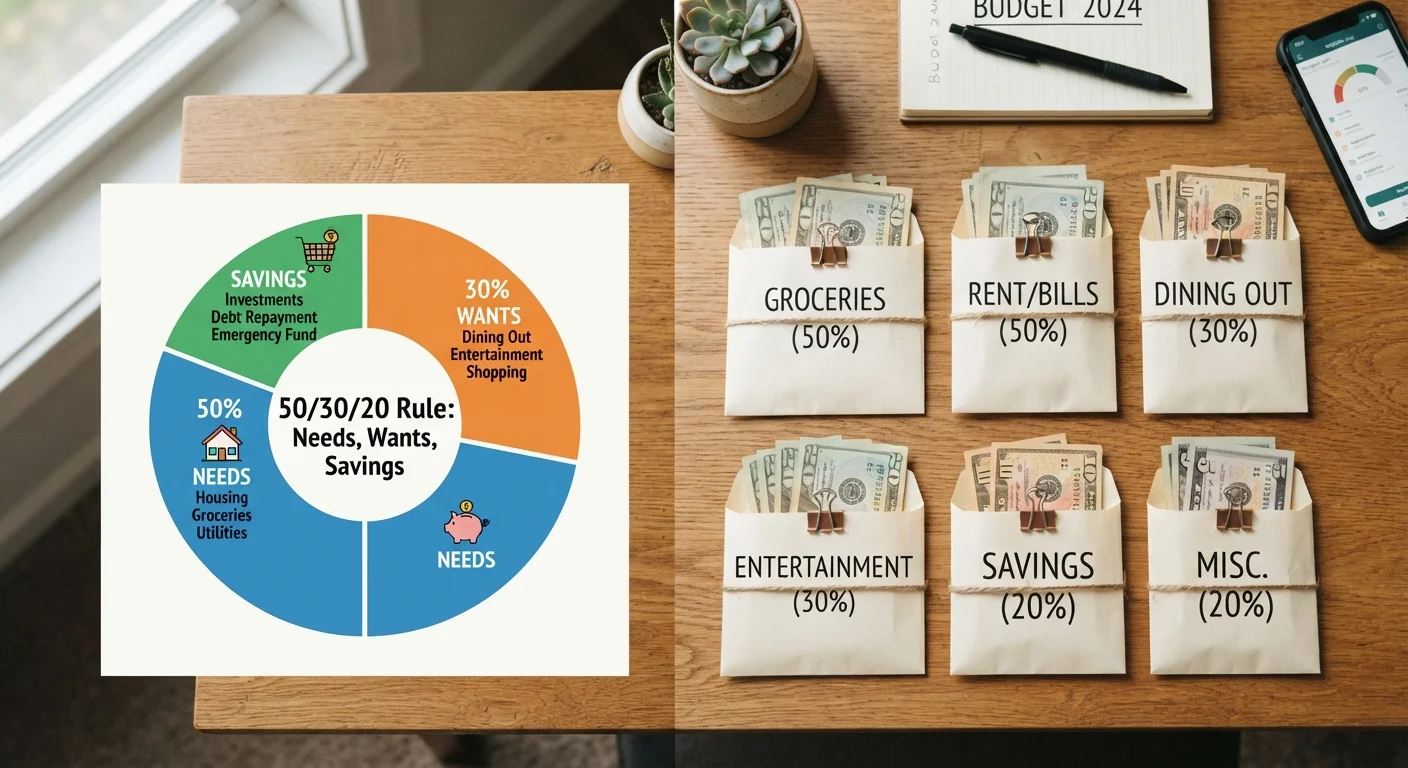

What the 50/30/20 Rule Is
The 50/30/20 rule is a percentage-based budgeting framework that divides your monthly after-tax income into three categories: needs (50%), wants (30%), and savings or debt repayment (20%). It was popularized in personal finance literature as a straightforward way to balance everyday expenses, discretionary spending, and long-term financial goals without tracking every dollar.
If you are new to structured budgeting, see our complete introduction to personal budgeting before applying this framework. For a deeper look at how the rule works in practice, the 50/30/20 rule explained covers when the framework works best for average earners.
| Framework type | Percentage-based budgeting |
| Income basis | After-tax (take-home) income |
| Needs allocation | 50% of after-tax income |
| Wants allocation | 30% of after-tax income |
| Savings/debt repayment allocation | 20% of after-tax income |
| Best suited for | Steady income earners seeking a simple, low-maintenance system |
| Minimum debt payments | Classified under Needs (50%), not the 20% bucket |
Category Definitions and What Qualifies
Understanding exactly which expenses belong in each bucket is essential before you allocate a single dollar.
Needs - 50%
Needs are non-negotiable expenses required to maintain basic living and employment. They include rent or mortgage payments, utilities, groceries, minimum debt payments, health insurance premiums, and essential transportation costs. If you could not function safely or keep your job without the expense, it is likely a need.
Wants - 30%
Wants are discretionary expenses that improve quality of life but are not survival requirements. Dining out, streaming subscriptions, gym memberships, travel, and hobby spending fall here. The line between needs and wants can blur - a basic phone plan is a need; an unlimited data upgrade is a want.
Savings and Debt Repayment - 20%
This category covers contributions to an emergency fund, retirement accounts, and other savings goals, plus any debt payments above the required minimums. Paying only minimum balances moves that portion to needs; extra payments belong here. Prioritizing high-interest debt within this 20% is generally sound financial practice, though a qualified financial adviser can help you sequence goals for your situation.
After-tax income
The amount of money you actually receive after federal, state, and payroll taxes are withheld. This is the figure used as the base for 50/30/20 calculations, not your gross salary.
Needs
Essential, non-negotiable expenses without which you could not maintain basic living or employment. Examples include housing, utilities, groceries, and minimum debt payments.
Wants
Discretionary spending that enhances lifestyle but is not strictly required for survival or employment. Dining out, entertainment, and travel are common examples.
Emergency fund
A liquid savings reserve set aside to cover unexpected expenses - such as medical bills or job loss - without resorting to high-interest debt. Typically recommended to cover three to six months of essential expenses.
Debt repayment (above minimums)
Any payment toward a debt that exceeds the lender's required minimum. These extra payments reduce principal faster, lower total interest paid, and belong in the 20% savings category under this framework.
Adapting the Rule to Real-Life Budgets
The 50/30/20 split is a starting point, not a fixed prescription. Several real-world conditions require deliberate adjustment.
- High cost-of-living areas: Housing alone may consume 40% of take-home pay. Consider temporarily narrowing wants to 20% to keep the savings rate intact, or explore income-boosting options.
- Variable income: Freelancers and gig workers should calculate allocations based on a conservative baseline monthly income rather than a high-earning month. Build a buffer in the savings bucket for low-income months.
- Significant debt load: If carrying high-interest debt, redirecting 5-10 percentage points from wants to debt repayment accelerates payoff and reduces total interest paid over time.
- Single income, dependents: Childcare and essential medical costs may push needs above 50%. Acknowledge the shortfall honestly, document it, and revisit the budget as circumstances change.
For a side-by-side comparison of this approach against a more granular method, see 50/30/20 vs. envelope budgeting. Once you have applied the rule for a month, run through the monthly budget health check checklist to see whether your actual spending matched your plan.
~33%
Average share of income spent on housing by US renters
According to U.S. Census Bureau American Community Survey data, many renters spend well above the 30% housing guideline, often requiring adjustments to the 50% needs allocation.
$6,000+
Median US household emergency fund shortfall
Research from the Federal Reserve's Report on the Economic Well-Being of U.S. Households has consistently found that a significant share of American adults could not cover a $400 unexpected expense without borrowing.
This article is for general informational purposes only and does not constitute personalized financial, tax, or legal advice. Consult a qualified financial professional before making decisions about your specific financial situation.