
Understanding Heart Rate Zones
Heart rate zones are a way of dividing exercise intensity into distinct bands, each associated with different physiological responses. While various systems use 5, 6, or 7 zones, the most widely used framework in endurance sports defines five zones anchored to your maximum heart rate (MHR).
Zone 1 is very light activity - a gentle walk. Zone 3 is a comfortably hard "tempo" effort. Zones 4 and 5 push into high intensity and near-maximum output. Zone 2 sits between these extremes: aerobically demanding enough to produce meaningful training adaptations, but low enough that the body stays in a steady, sustainable metabolic state.
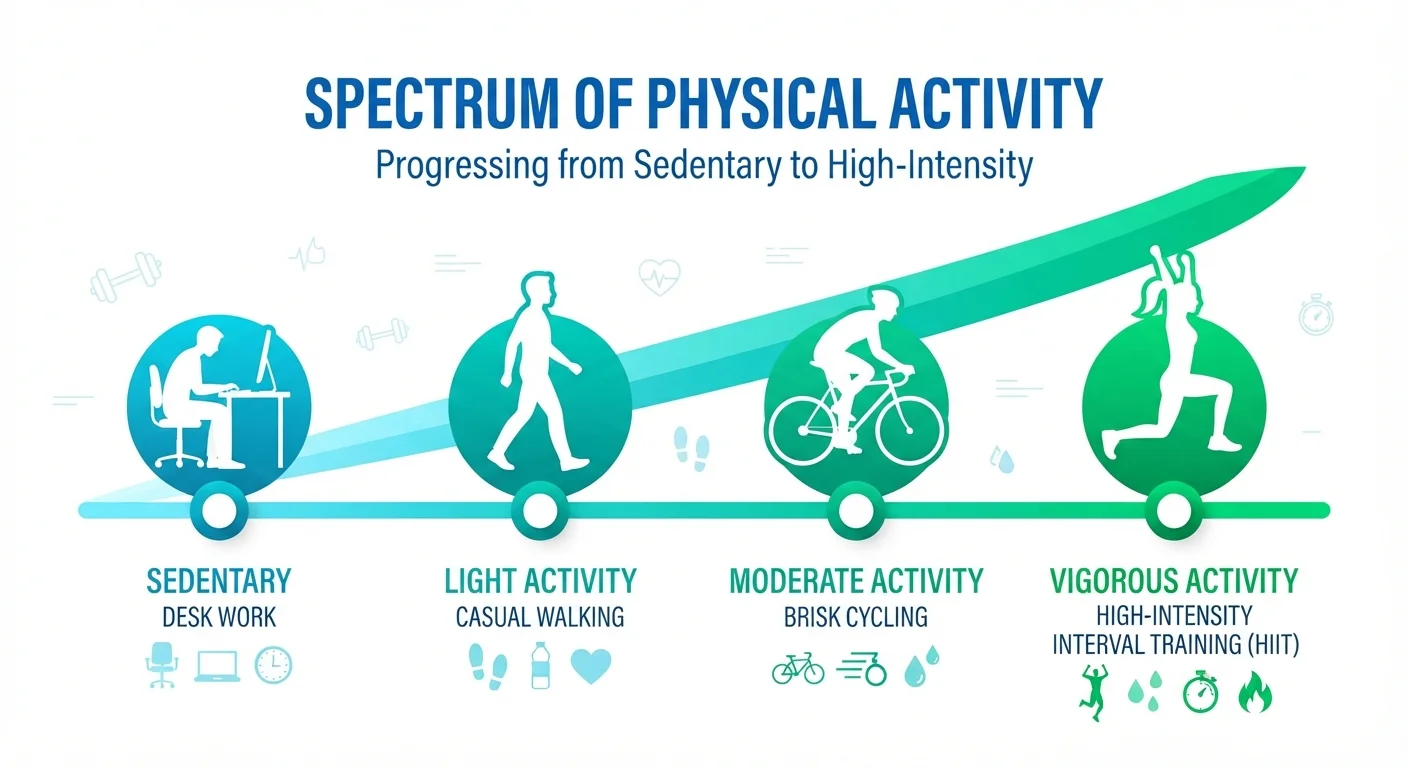
Estimating your MHR is imperfect without a lab test. The common formula of 220 minus your age is a rough population average with significant individual variation. Devices that monitor heart rate during a graded exercise test offer better accuracy. For the purposes of Zone 2, the talk test is a practical and validated proxy for most people. See our guide to the full activity spectrum for context on how Zone 2 fits within the broader landscape of exercise intensity.
70-80%
Zone 2 share of elite endurance training volume
Research on Olympic and professional endurance athletes consistently documents this low-intensity training distribution in published sports science literature.
~60-70%
Of maximum heart rate for Zone 2
This range is the most commonly cited target in five-zone heart rate frameworks used by coaches and exercise physiologists.
30-45 min
Minimum session duration for meaningful aerobic stimulus
Exercise scientists generally recommend this minimum duration to generate significant mitochondrial and cardiovascular adaptations from low-intensity training.
The Science Behind Zone 2 Adaptations
When you exercise at Zone 2 intensity, your muscles rely predominantly on aerobic metabolism - using oxygen to convert fat and carbohydrates into energy. Over weeks and months of consistent training, this stress drives several measurable adaptations.
Mitochondrial density: Research shows that sustained low-intensity aerobic training increases the number and efficiency of mitochondria - the cellular structures responsible for energy production. More mitochondria mean greater capacity to produce energy aerobically, which translates to improved endurance and reduced fatigue at any given effort level.
Fat oxidation efficiency: Zone 2 training shifts the muscle's fuel preference toward fat at higher workloads. This matters for endurance performance because fat stores are virtually unlimited compared to glycogen (the stored form of carbohydrate), which can be depleted within 60-90 minutes of intense exercise.
Cardiovascular adaptations: Consistent aerobic training at any moderate intensity strengthens the heart muscle, increases stroke volume (the amount of blood pumped per beat), and improves capillary density in muscle tissue - all contributing to a lower resting heart rate and better oxygen delivery.
“The aerobic base is the foundation on which all other fitness qualities are built. Without sufficient low-intensity volume, athletes often find their high-intensity ceiling is lower than it could be.”
— Iñigo San Millán, Exercise physiologist and endurance sports researcher, University of Colorado
Why Elite Athletes Train So Easy
It may seem counterintuitive that world-class marathoners, cyclists, and triathletes spend the majority of their training time at an intensity that feels almost too comfortable. But this approach - sometimes called the 80/20 or polarized training model - is well-documented in sports science literature.
Studies of elite endurance athletes consistently show that approximately 70-80% of their training volume occurs at low intensity (Zone 1-2), with the remaining volume at higher intensities. This distribution allows athletes to accumulate large training loads without generating excessive physiological stress, preserving their ability to perform hard efforts on key sessions and reducing injury and burnout risk.
The practical insight for non-elite exercisers is that many recreational athletes train too hard on easy days, inadvertently pushing into Zone 3 - an intensity sometimes called the "gray zone" because it is neither easy enough to promote full aerobic adaptations nor hard enough to deliver the peak benefits of true high-intensity work. See how Zone 2 training compares to strength work in our article on cardio vs. strength training.
Avoid the 'Gray Zone' Trap
Many people habitually train at a moderate-hard effort - fast enough to feel productive, but not hard enough to be truly high-intensity. This Zone 3 'gray zone' accumulates fatigue without maximizing the unique benefits of either low- or high-intensity training. On designated easy days, actively resist the urge to push harder than a comfortable, conversational pace.
Applying Zone 2 to Your Own Training
You don't need to be training for an Ironman to benefit from Zone 2 cardio. The underlying metabolic adaptations - improved fat oxidation, mitochondrial efficiency, cardiovascular health - are relevant for general health as much as for athletic performance.
Common Zone 2 activities include brisk walking, easy jogging, cycling at a moderate pace, rowing, and swimming. The defining feature is maintaining that sustainable, conversational intensity, not the specific activity.
This article is for general informational and educational purposes only and is not a substitute for personalized medical or fitness advice. Consult a qualified healthcare professional before beginning or significantly changing an exercise program, particularly if you have any underlying health conditions.