
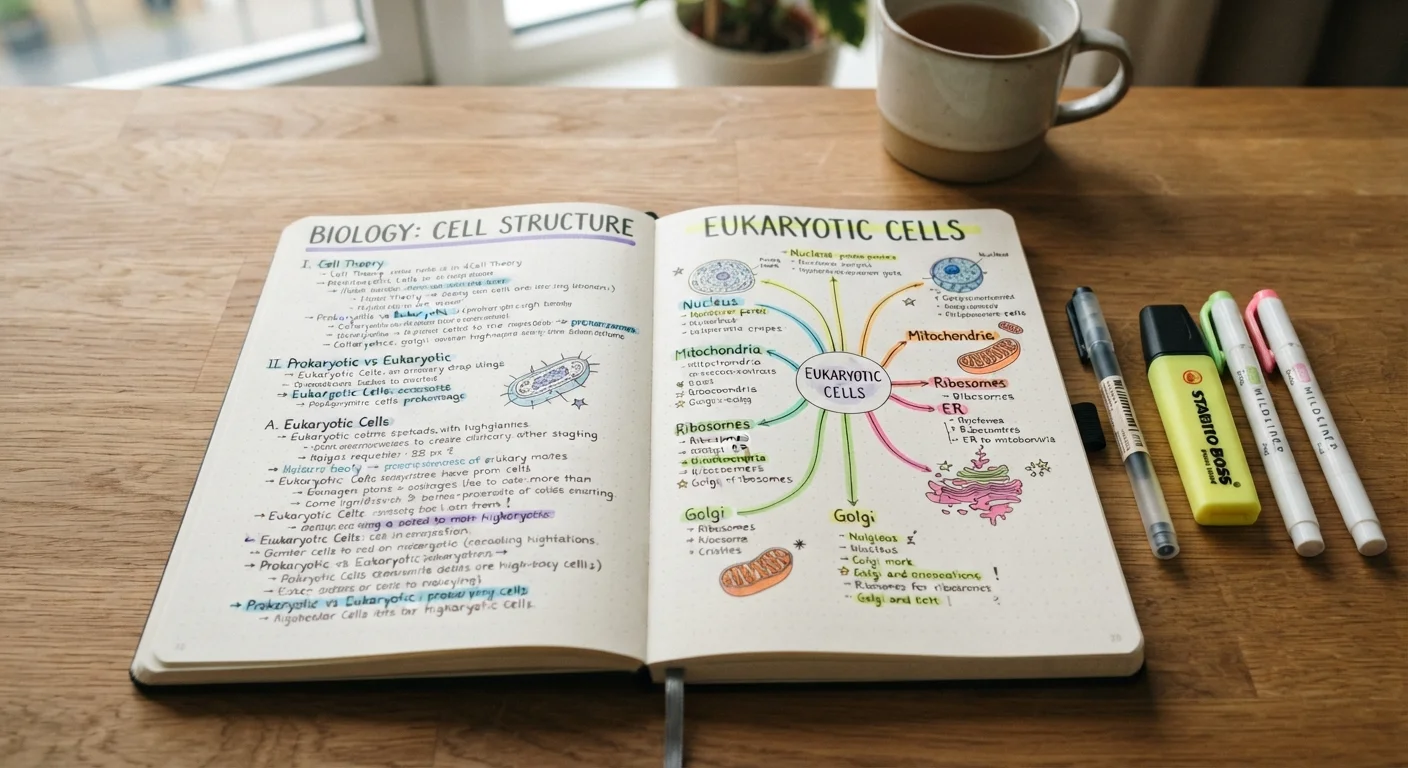
Why Your Note-Taking Method Matters
Note-taking is not simply a recording task - it is an active cognitive process that shapes how information is encoded in memory. Research in learning science consistently suggests that how you organize information as you capture it affects how readily you can retrieve it later. Choosing a method that matches both the material and your cognitive preferences can make study sessions significantly more productive.
This comparison covers four widely used systems: the Cornell Method, outlining, mind mapping, and the sentence method. Each is evaluated on structure, flexibility, suitability for different subjects, and how well it supports review. For a deeper look at why review strategies matter, see why active recall outperforms rereading.
The Four Methods at a Glance
Before diving into each method individually, the table below offers a quick side-by-side comparison across key criteria.
| Cornell Method | Outlining | Mind Mapping | Sentence Method | |
|---|---|---|---|---|
| Page structure | Divided into cue, notes, summary | Indented hierarchical levels | Central node with radiating branches | Sequential numbered lines |
| Speed during lecture | Moderate | Fast | Slow | Very fast |
| Review suitability | Excellent - built-in self-testing | Good with clear headings | Good for concept relationships | Requires post-session editing |
| Visual appeal | Structured, text-based | Clean and hierarchical | Highly visual and spatial | Plain, minimal formatting |
| Best subject fit | Sciences, law, history | Structured lectures, textbooks | Conceptual, creative subjects | Any fast-moving content |
| Learning style match | Sequential, detail-oriented | Logical, organized thinkers | Visual-spatial learners | Flexible, capture-first thinkers |
| Digital tool support | Moderate | Excellent | Good (dedicated apps) | Excellent |
Cornell Method: Built for Review
Developed at Cornell University, this system divides a page into three zones: a narrow left-hand cue column, a wide right-hand notes column, and a summary section at the bottom. During a lecture or reading, you fill in the notes column. Afterward, you write questions or keywords in the cue column that correspond to what you've written - turning your notes into a self-testing tool.
The summary section forces you to synthesize the page's content in your own words, reinforcing understanding. This built-in structure aligns well with retrieval practice principles backed by cognitive research.
Best for: Courses with dense factual content, exam-heavy curricula, and learners who benefit from structured review routines. Less ideal for highly visual subjects or fast-paced lectures where writing time is limited.
Maximize Cornell with a Review Ritual
Set aside ten minutes after each class to write your cue-column questions and complete the summary section while the material is still fresh. This brief post-session step is where much of the Cornell Method's retention benefit is earned - skipping it reduces the system to a standard note-taking page. Scheduling this habit alongside your learning plan makes it easier to sustain.
Outlining: Hierarchy Made Visible
Outlining uses indented levels - main topics, subtopics, and supporting details - to reflect the logical structure of the source material. It is intuitive when the instructor or text follows a clear sequence, and it makes hierarchical relationships immediately visible on the page.
Digital outlining tools allow easy reordering, collapsing of sections, and keyword searching, making this method particularly powerful for learners in hybrid or asynchronous settings. For more on how learning formats affect study habits, see synchronous vs. asynchronous learning.
Best for: Structured lectures, textbook chapters, and content with clear main points and sub-points. Less effective when material is conceptually tangled or when connections between ideas matter more than sequence.
Mind Mapping: Thinking in Networks
A mind map starts with a central concept placed in the middle of the page, with branches radiating outward to related ideas, sub-branches, and supporting details. The spatial, non-linear layout mirrors how many people naturally associate ideas, making it especially useful for brainstorming, essay planning, and subjects where relationships between concepts are as important as the concepts themselves.
Mind mapping tends to suit visual-spatial learners and is widely used in subjects like biology, history, and literature where themes interconnect. It is less practical during fast-moving lectures, as constructing the visual structure takes more time than linear note-taking.
Mind Mapping Has a Learning Curve
First-time mind mappers sometimes find the open-ended format overwhelming, especially under time pressure. Practice constructing maps from completed notes before attempting them live in class. Starting with simple two-level maps - a central topic and five to seven branches - builds confidence before adding complexity.
Best for: Concept mapping before a paper, reviewing relationships between topics, and creative or interdisciplinary subjects.
Sentence Method and Choosing Your Approach
The sentence method involves writing each new thought or fact on its own numbered line, without imposing structure in the moment. It prioritizes speed and completeness over organization, making it useful when content arrives quickly or unpredictably. The trade-off is that post-session organization is required - raw sentence notes demand follow-up editing to become useful study material.
No single method dominates all contexts. Many effective learners use outlining during class, then restructure key sections into Cornell format before exams, or sketch a mind map to plan an essay. Building this kind of intentional flexibility is one component of a strong academic skill set. Pairing your chosen method with a thoughtful study schedule - see how to build a study schedule you'll actually stick to - helps ensure your notes get reviewed, not just created.