Why Popular Study Habits Often Fall Short
Most students default to highlighting, rereading, and marathon study sessions before a test. These strategies feel productive - the familiarity of the material creates a sense of mastery. But cognitive researchers call this the fluency illusion: recognizing something is not the same as being able to recall or apply it later.
Decades of research consistently show that passive review methods produce weak, short-lived retention. The good news is that the strategies which do work are accessible to anyone willing to restructure their study habits. The academic skills literature points repeatedly to three core techniques: spacing, retrieval practice, and interleaving.
The Spacing Effect: Study a Little, Often
The spacing effect refers to the well-documented finding that spreading learning across multiple sessions - with gaps in between - produces far better retention than covering the same material in one long sitting. When you return to material after a delay, your brain must work to reconstruct that knowledge, and that effortful reconstruction strengthens the memory trace.
~50%
Information forgotten within an hour without review
Research building on Hermann Ebbinghaus's foundational forgetting curve studies estimates roughly half of new information is lost within 60 minutes of learning without any form of review or practice.
2x+
Retention advantage of spaced vs. massed practice
Multiple meta-analyses in cognitive psychology, including work by Cepeda and colleagues, have found that spaced practice can more than double long-term retention compared to equivalent time spent in a single session.
A practical approach: instead of reviewing a new concept once for 60 minutes, review it for 20 minutes today, again in two days, and once more the following week. Each session can be shorter, and the total time investment is often similar - but the retention outcome is substantially better.
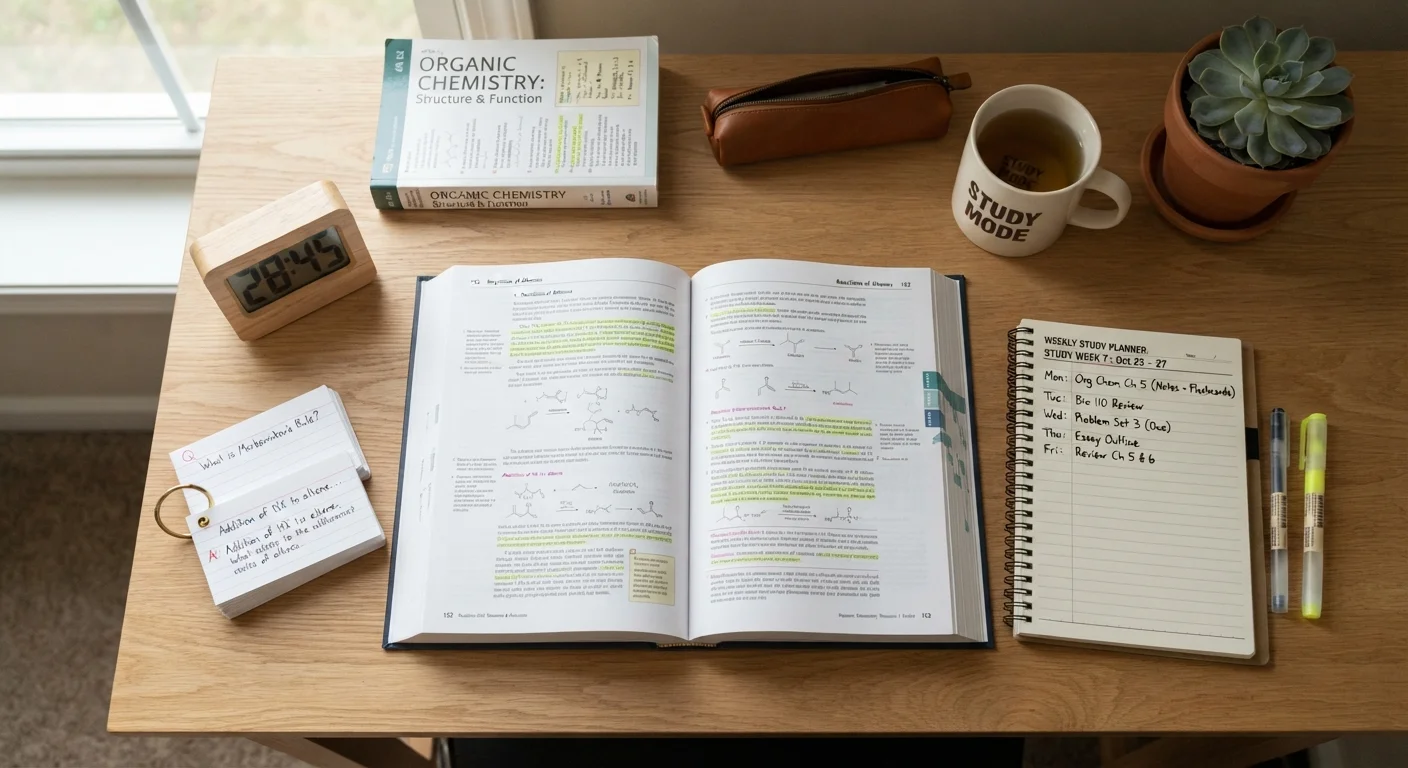
Spacing works especially well when paired with a calendar or planner. Scheduling future review sessions at the end of each study block removes the guesswork and keeps the gaps consistent. For adult learners balancing work and study, this also makes learning feel more manageable. See also: evidence-informed study habits for adult learners.
Retrieval Practice: Test Yourself Before the Test Tests You
Retrieval practice - also called the testing effect - means actively pulling information from memory rather than passively reviewing it. Flashcards, practice questions, self-quizzing, and writing from memory all count. The act of retrieval itself changes the memory: each successful recall makes the information easier to access in the future.
“Testing is not just a measurement tool - it is a powerful means of promoting learning and retention, often more effective than additional study time alone.”
— Henry L. Roediger III, Cognitive psychologist and memory researcher, Washington University in St. Louis
Crucially, retrieval practice works even when you get answers wrong. Struggling to retrieve something, then checking the correct answer, produces a strong encoding effect. This is why low-stakes self-testing is so valuable throughout a learning period - not just the night before an assessment.
If you're building this habit, start simply: after reading a section, close the book and write down everything you can remember. Then check. This approach pairs naturally with the Cornell note-taking method, which structures notes to support self-quizzing - explore that connection in our note-taking methods comparison. For a deeper dive into why active recall outperforms passive review, see active recall vs. passive review.
Interleaving: Mix It Up to Deepen Understanding
Interleaving means mixing different topics, subjects, or problem types within a single study session, rather than completing all practice on one topic before moving to the next (called blocking). While blocked practice can feel smoother and more comfortable, interleaving forces the brain to actively identify what kind of problem it's facing and which strategy applies - a process that builds more flexible, transferable knowledge.
Use spaced repetition scheduling to plan your review sessions in advance.
Memory fades predictably over time - a pattern known as the forgetting curve. Reviewing material at strategically increasing intervals targets the moment just before forgetting occurs, which maximizes the strengthening effect of each review.
Replace rereading with self-quizzing as your default review method.
Rereading builds familiarity, not recall. Active retrieval forces your brain to reconstruct knowledge from scratch, which is the process that makes memories durable and accessible under pressure.
Interleave problem types or topics within each practice session rather than finishing one topic at a time.
Blocking practice on a single topic creates an illusion of mastery without building the ability to discriminate between problem types. Interleaving requires the learner to identify the correct strategy for each item, building more robust, transferable skills.
Embrace the difficulty of effortful recall rather than seeking smooth, comfortable review.
Research on 'desirable difficulties' shows that strategies that feel harder in the moment - like retrieval practice and interleaving - produce stronger long-term retention than those that feel easier. Difficulty is often a sign that productive learning is occurring.
Research on mathematics learning, for example, finds that students who interleave different problem types during practice outperform those who block by topic on delayed tests - even when blocked students feel more confident after studying. The discomfort of interleaving is a signal that deeper processing is occurring.
A simple way to interleave: gather practice problems or flashcards from multiple recent topics and shuffle them before each session. The slight friction this creates is exactly the mechanism driving better long-term learning.
Putting It All Together: A Practical Framework
These three techniques are most powerful when used in combination. A well-designed study session might look like this: you begin by self-testing on material from a previous session (retrieval practice), then study new content, then practice problems that mix new and older material together (interleaving), and finally schedule your next review session a few days out (spacing).
None of this requires special tools or apps - a notebook, index cards, and a calendar are enough to implement all three strategies fully. What matters most is intentionality: replacing passive review with active, effortful engagement each time you sit down to study.
Understanding why these techniques work can also help maintain motivation. The science behind adult brain learning offers useful context on neuroplasticity and how effort-based learning reshapes memory over time.
Start Small to Build the Habit
You don't need to overhaul your entire study routine at once. Pick one technique - such as ending each session with a five-minute self-quiz - and practice it consistently for two weeks. Once that feels automatic, layer in spaced scheduling or interleaving. Small, sustainable changes compound into significantly better learning outcomes over time.