
Why Time Management Looks Different at Every Level
A high school freshman and a doctoral candidate face structurally different days, but they share one core challenge: more to do than time naturally allows. What changes across academic levels is not the need for time management - it's the degree of self-direction required to practice it.
In high school, bells, homeroom, and parental oversight provide an external structure. By college, that structure largely disappears. Graduate school adds independent research, teaching duties, and professional development on top of coursework. At each transition, students who relied on external scaffolding without building internal habits tend to struggle most.
The principles covered here are designed to hold across all those contexts. They are part of the broader skill set explored in our complete academic skills resource for students at every level.
Structure Shifts, Principles Don't
High school students working within a highly scheduled day should still practice capturing commitments and breaking projects into steps - the habits matter even when the external structure exists. Building them early makes the transition to college's self-directed environment far less disorienting.
Core Principles That Scale
These practices form the foundation of effective academic time management regardless of grade level, institution type, or course load. Apply them in a way that fits your current situation.
Capture every commitment in one centralized system
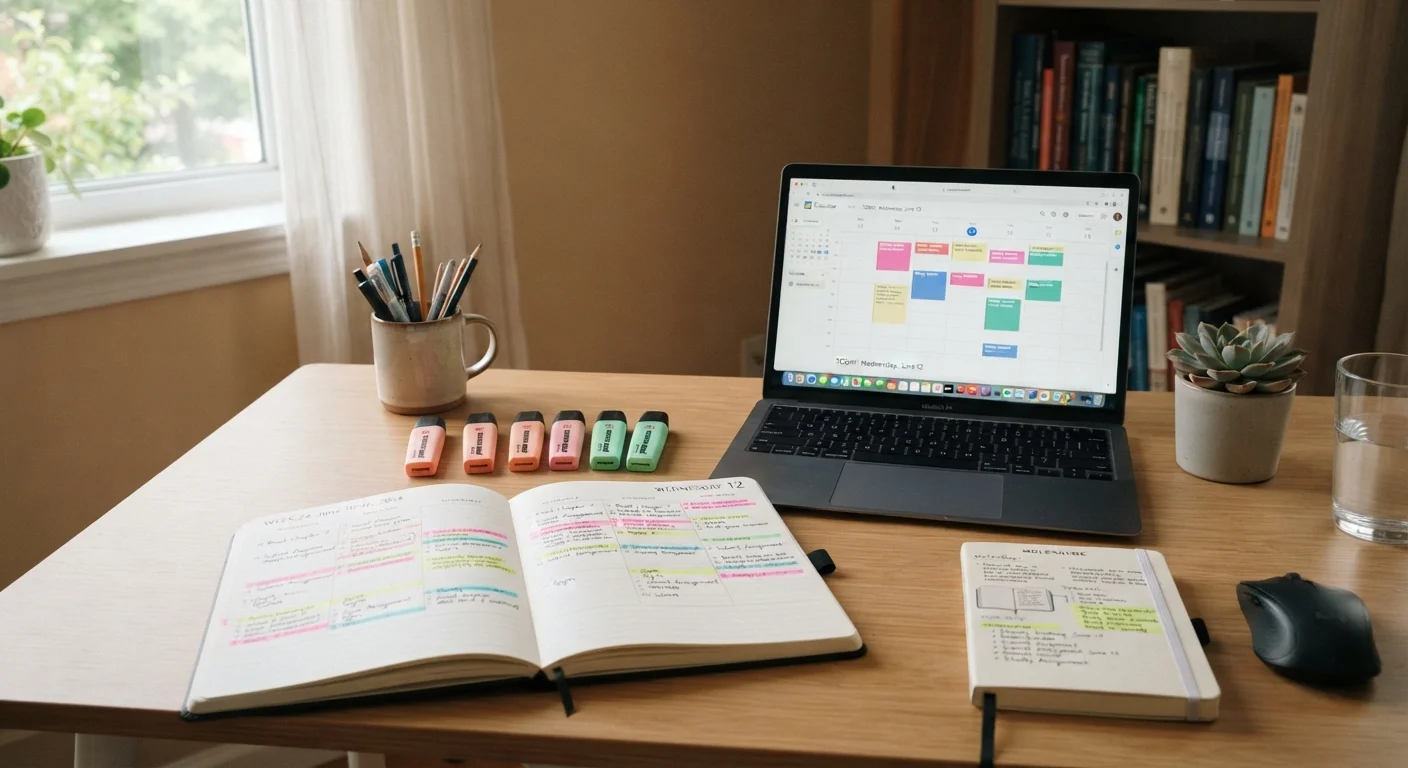
Relying on memory to track assignments, exams, and obligations spreads cognitive load and leads to missed deadlines. A single trusted system - whether a physical planner or a digital calendar - ensures nothing falls through the cracks and frees mental energy for actual learning.
Break large projects into dated, smaller tasks
Large assignments like research papers or comprehensive exams feel unmanageable as single items, which causes avoidance. Decomposing them into dated subtasks - choose a topic by Tuesday, outline by Friday - makes progress concrete and measurable.
Identify your peak energy hours and protect them for deep work
Not all study hours are equal. Attempting difficult cognitive tasks when your alertness is naturally low wastes time and produces weaker results. Matching your hardest work to your sharpest hours multiplies effectiveness without adding hours.
Build buffer time around every major deadline
Unexpected illness, technical failures, or underestimated task complexity are normal, not exceptional. Treating buffer time as a structural feature - not a luxury - prevents one disruption from cascading into multiple missed deadlines.
Schedule recovery time as deliberately as study time
Sleep, physical movement, and unstructured downtime are not concessions to weakness - they are biological requirements for memory consolidation and sustained cognitive performance. Students who chronically sacrifice rest see diminishing returns on study hours.
Turning Principles Into a Working System
Principles are only useful when they translate into daily behavior. The bridge between intention and execution is a reliable scheduling system - one you actually use. Our guide on building a study schedule you'll actually stick to walks through how to design one around your real course load and energy levels.
87%
Students reporting time management as a top challenge
According to surveys consistently conducted by university academic success centers, the majority of struggling undergraduates cite poor time management - not academic ability - as their primary obstacle.
2x
Productivity gain from scheduling deep work blocks
Research in cognitive psychology suggests that focused, distraction-free work sessions can produce roughly twice the output of equivalent hours spent in fragmented, interrupted study conditions.
For adult learners juggling work and family, the complexity increases further. The article on returning to school as a working adult addresses those layered demands directly. Meanwhile, if your program involves flexible or asynchronous delivery, reviewing how synchronous vs. asynchronous formats affect scheduling can help you pick a structure that suits your life.
The Long View: Building a Habit, Not Just a Schedule
Time management is not a one-time fix - it's a habit that must be rebuilt each semester as workloads, formats, and personal circumstances shift. Students who treat it as a living system, revisiting and adjusting regularly, outperform those who set a schedule once and abandon it when it stops working.
This connects to the broader goal of building a personal learning habit that actually sticks - making self-directed time use a durable part of how you operate, not just an academic survival tactic.
“Time is the scarcest resource, and unless it is managed, nothing else can be managed.”
— Peter Drucker, Management educator and author on effectiveness and productivity
Start with two or three of the practices above, build consistency, then add complexity. Sustainable time management at any academic level grows from small, reliable behaviors repeated over time.