How Each Format Actually Delivers Learning
Audiobooks are recorded versions of full-length books - typically nonfiction, memoir, or narrative - narrated straight through from introduction to conclusion. The listener follows one author's sustained line of reasoning, often across eight to fifteen hours of content. That structure mirrors how textbooks and formal courses work: ideas build on each other, and skipping ahead can leave gaps.
Podcasts work differently. An episode might be fifteen minutes or two hours, and a series rarely requires you to have heard previous episodes to follow along. Hosts often interview guests, debate ideas, or report on current events - meaning any single episode can expose you to multiple viewpoints rather than one author's thesis.
This structural difference is the core of the comparison. As the reading comprehension vs. speed reading distinction illustrates, how you consume information shapes what you retain. Audiobooks invite comprehension-style engagement; many podcast episodes encourage a lighter, exploratory mode.
| Criterion | Audiobooks | Podcasts |
|---|---|---|
| Typical length | 6-15 hours per title | 15-90 minutes per episode |
| Structure | Linear, sequential argument | Modular, often standalone episodes |
| Depth of coverage | High - one subject explored fully | Variable - depends on episode format |
| Currency of content | Fixed at time of publication | Frequently updated, often current |
| Perspective | Single author's viewpoint | Often multiple guests or voices |
| Flexibility for interrupted listening | Lower - continuity matters | Higher - episodes are self-contained |
| Editorial oversight | Publisher-reviewed and edited | Varies widely by producer |
Depth vs. Breadth: Matching Format to Your Goal
If your goal is to genuinely understand a subject - its principles, its exceptions, its nuances - audiobooks tend to serve that goal better. A well-written nonfiction audiobook forces an author to build a coherent case across hundreds of pages. That editorial discipline produces a kind of depth that a 40-minute interview rarely can.
If your goal is breadth - staying current, sampling multiple expert perspectives, or discovering new topics - podcasts are hard to beat. A learner who subscribes to three or four podcasts in their field of interest will hear from dozens of practitioners, researchers, and thinkers over the course of a year, often covering ideas that haven't yet made it into a published book.
This mirrors a broader question about personal learning strategy. Reading deeply vs. reading widely explores the same tension in a reading context - and the same logic applies to audio. Neither approach is universally better; the right choice depends on where you are in learning a subject.
67%
US adults who listen to podcasts monthly
According to Edison Research's Infinite Dial study, podcast listenership among Americans has grown steadily, with a majority listening at least monthly as of recent surveys.
~8 hrs
Average audiobook listening per week among users
The Audio Publishers Association has reported that regular audiobook listeners consume several hours of content weekly, often during commutes or exercise.
74%
Podcast listeners who tune in to learn something new
Edison Research findings suggest the majority of podcast listeners cite learning and education as a primary motivation for listening.
Attention, Retention, and the Practical Reality
One honest limitation of both formats: passive listening while multitasking reduces retention measurably. Research in cognitive psychology consistently shows that divided attention during learning impairs encoding - the brain's process of converting short-term experience into longer-term memory. Whether you're listening to a podcast while cooking or an audiobook during a commute, background listening is better than nothing, but it's not equivalent to focused study.
Audiobooks tend to suffer more from this because they require you to hold a developing argument in working memory across sessions. Miss a chapter's key premise because your mind wandered, and the next chapter may not make sense. Podcasts, being more modular, are more forgiving - each episode typically reintroduces its own context.
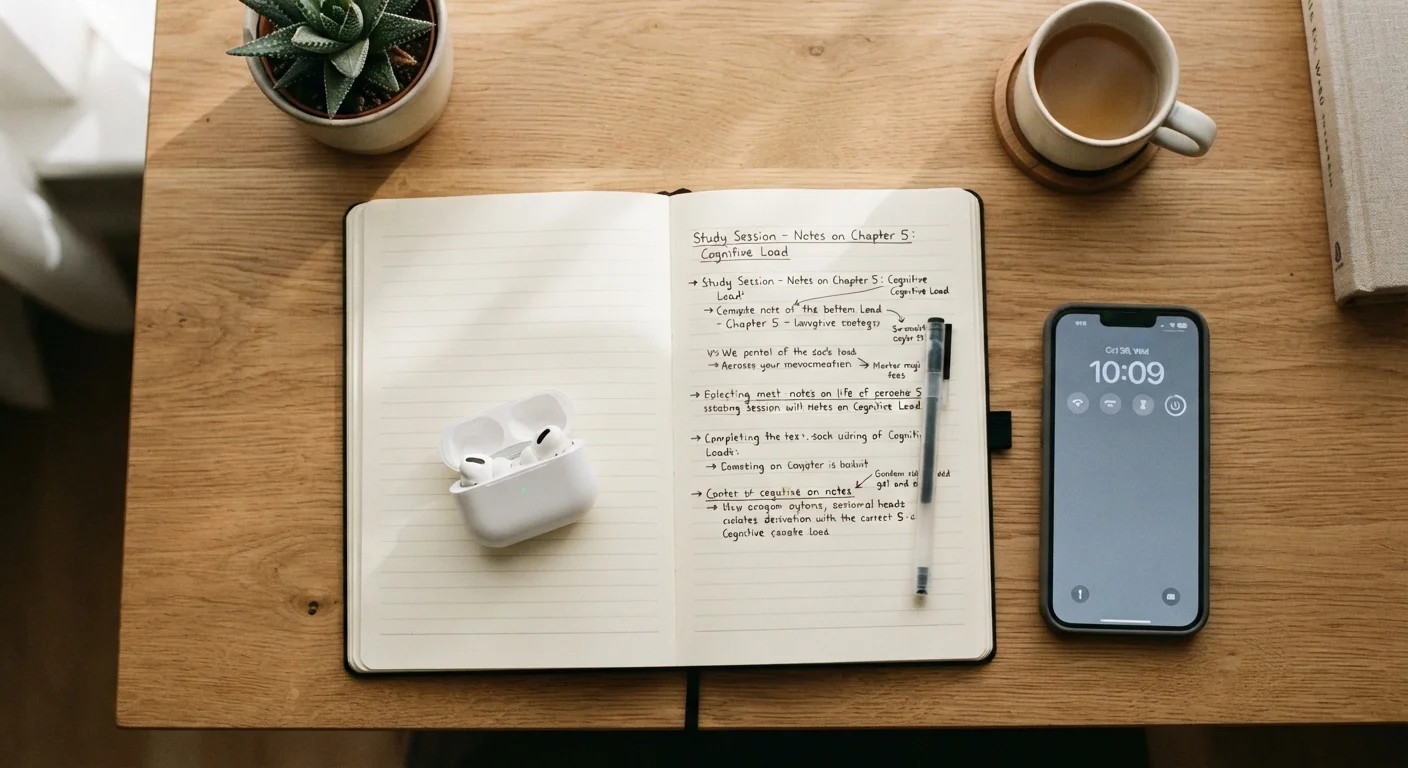
If retention matters to you, consider pairing either format with brief note-taking or reflection after listening. Even two or three written sentences summarizing what you heard can significantly improve recall. For learners exploring how format affects their study habits more broadly, synchronous vs. asynchronous learning offers a useful parallel about how structure shapes what sticks.
A Note on Audio Quality and Narrator Skill
For audiobooks, the narrator's performance meaningfully affects comprehension and engagement. A flat or poorly paced delivery can make dense nonfiction harder to follow than the print version. When evaluating an audiobook, previewing a sample chapter first is a practical way to assess whether the narration style suits your learning preferences. Podcast audio quality varies similarly - production values differ widely across independent and professionally produced shows.
When Combining Both Makes Sense
Many active learners use both formats intentionally: audiobooks to build foundational knowledge in a subject, podcasts to stay current and fill in new angles. For example, someone learning about behavioral economics might start with an audiobook treatment of the field's key concepts, then subscribe to a podcast covering new research and applications as they emerge.
The choice isn't permanent either. You might lean on podcasts during a busy stretch when long-form attention isn't realistic, and return to audiobooks during slower periods when focused listening is possible. Formal courses, self-study, or mentorship explores a similar idea - matching learning formats to life circumstances rather than committing to one approach indefinitely.
Both audiobooks and podcasts are genuinely valuable tools for self-directed learning. The question isn't which one is better - it's which one fits the learning goal in front of you right now.