Why Your Note-Taking Method Matters
Most adults learned to take notes by copying what was on the board or scribbling everything a speaker said. That approach often produces pages of text that are hard to revisit and even harder to actually use. Effective note-taking isn't about transcription - it's about processing information in a way that moves it from short-term attention into longer-term understanding.
Research in learning science consistently distinguishes between passive and active engagement with material. Notes taken with a clear structure force you to decide what matters, make connections, and anticipate questions - cognitive steps that passive copying skips. If you want to understand why that distinction is so consequential, the active recall vs. passive review framework explains the underlying mechanism well.
Below are five established note-taking methods suited to adult learners. Each has a different shape, logic, and best use case. Try more than one before deciding which fits your thinking style and subject matter.
The Cornell Method
Developed at Cornell University in the 1950s, this method divides each page into three sections: a narrow left column for cue questions, a wider right column for notes taken during learning, and a bottom strip for a brief summary.
During a lecture or reading, you write notes on the right. Afterward - ideally within 24 hours - you formulate questions in the left column that your notes answer. The summary at the bottom distills the page's main idea in your own words.
This structure makes the Cornell method especially effective for adult learners because the cue column essentially builds review prompts into the page itself, supporting the kind of active recall that outperforms passive rereading for long-term retention. It works well for lectures, textbook chapters, and online course modules.
Cornell's cue column turns your notes into a built-in self-quiz every time you review them.
Mind Mapping
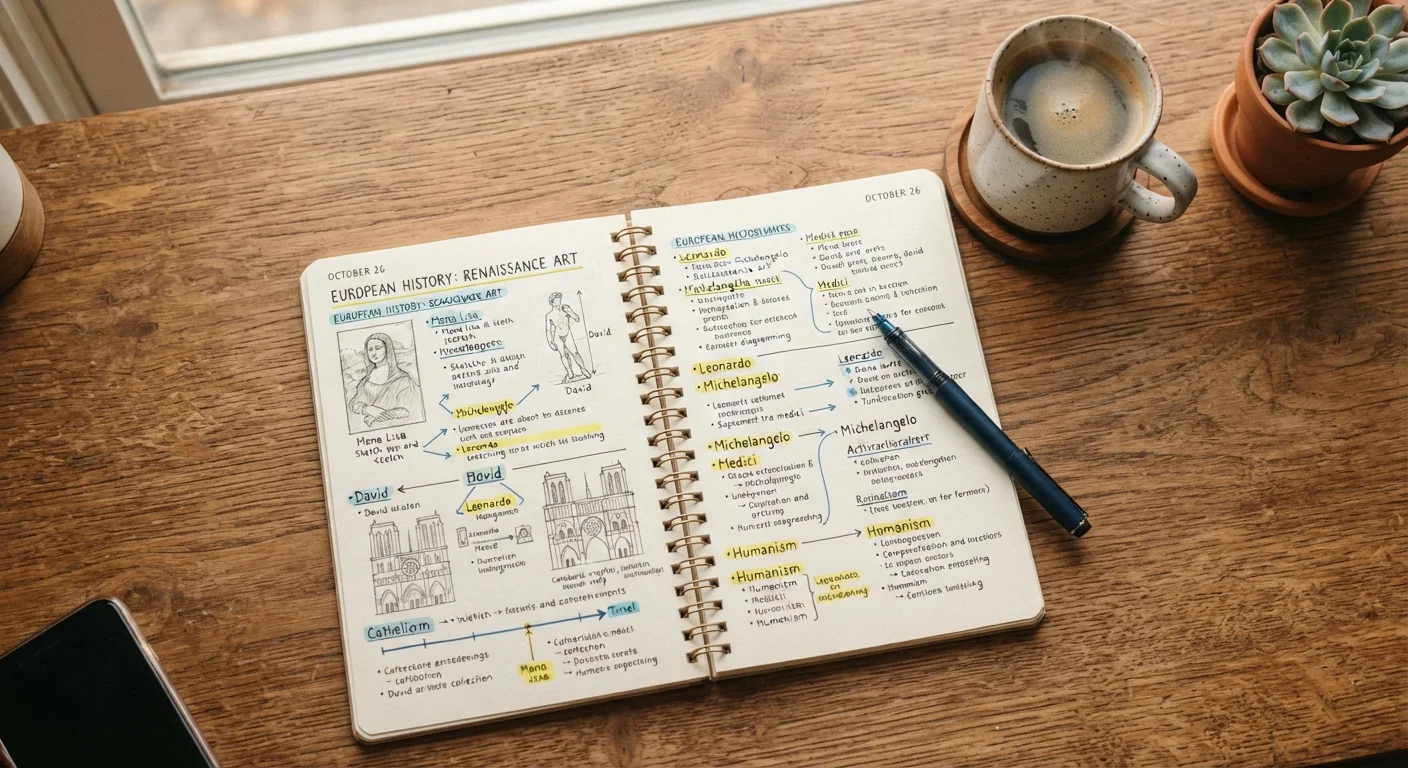
A mind map places a central concept at the page's center, then branches outward with related ideas, subtopics, and supporting details. Connections between branches can be drawn with lines or color-coded to show relationships.
This method suits learners who think visually or who are exploring a broad topic with many interconnected parts - brainstorming a research paper, mapping a new field of study, or planning a project. It's less suited to capturing sequential information like step-by-step procedures.
Mind maps can be drawn by hand or built with free digital tools. The act of deciding where a concept fits on the map is itself a comprehension check - if you can't place an idea, you may not yet fully understand it. For a side-by-side comparison of mind mapping and other systems, that resource covers the tradeoffs in detail.
Deciding where an idea fits on a mind map is itself a test of whether you truly understand it.
The Outline Method
The outline method organizes information hierarchically: main topics at the top level, subtopics indented below, and supporting details indented further. It mirrors the logical structure of most textbooks and well-organized lectures.
Its strength is clarity. When material has a clear structure - numbered steps, cause-and-effect chains, historical sequences - outlining captures that structure faithfully. The visual hierarchy also makes it easier to scan for a specific point during review.
Its limitation is flexibility: loosely organized content or free-flowing discussions can be hard to outline in real time. Many adult learners find the outline method most useful for textbook reading rather than live lectures, because you can pause and think about where each point fits before writing it down.
Outlining works best when the source material already has a clear, logical hierarchy to mirror.
The Sentence Method
The sentence method is exactly what it sounds like: you write each new thought, fact, or idea as a separate, numbered sentence on a new line. There is no imposed hierarchy - each point gets equal visual weight.
This approach is fast, which makes it useful in fast-paced lectures or discussions where pausing to format would cause you to miss content. It also captures nuance and exact phrasing better than highly compressed formats.
The tradeoff is that sentence-method notes require more active processing after the fact. Because no hierarchy is built in, you need to return to your notes and reorganize or annotate them - a step many learners skip but that significantly increases the method's value. Pairing this with the study habits outlined in Making Knowledge Stick can help you get more out of that post-session review.
The sentence method captures content quickly, but its real value depends on thoughtful post-session review.
The Charting Method
The charting method uses a table structure to organize information into predefined categories across columns. You set up column headers before the session - for example, Term | Definition | Example | Application - and populate the rows as you learn.
This method excels when the material naturally fits a comparative structure: vocabulary-heavy subjects, historical periods, biological classifications, or any topic where you're learning multiple attributes of multiple items simultaneously.
It requires some advance knowledge of what categories matter, which makes it less flexible for exploratory learning. But for structured subjects where you know the shape of the content ahead of time, charts reduce cognitive load during note-taking by giving you a predictable place to put every piece of information. It also produces notes that are exceptionally easy to review, because the tabular format is essentially a study guide already. See the Academic Skills hub for more strategies that complement structured approaches like this one.
Charting reduces cognitive load by giving every piece of information a predictable place to land.
Building the Habit Into Your Learning Practice
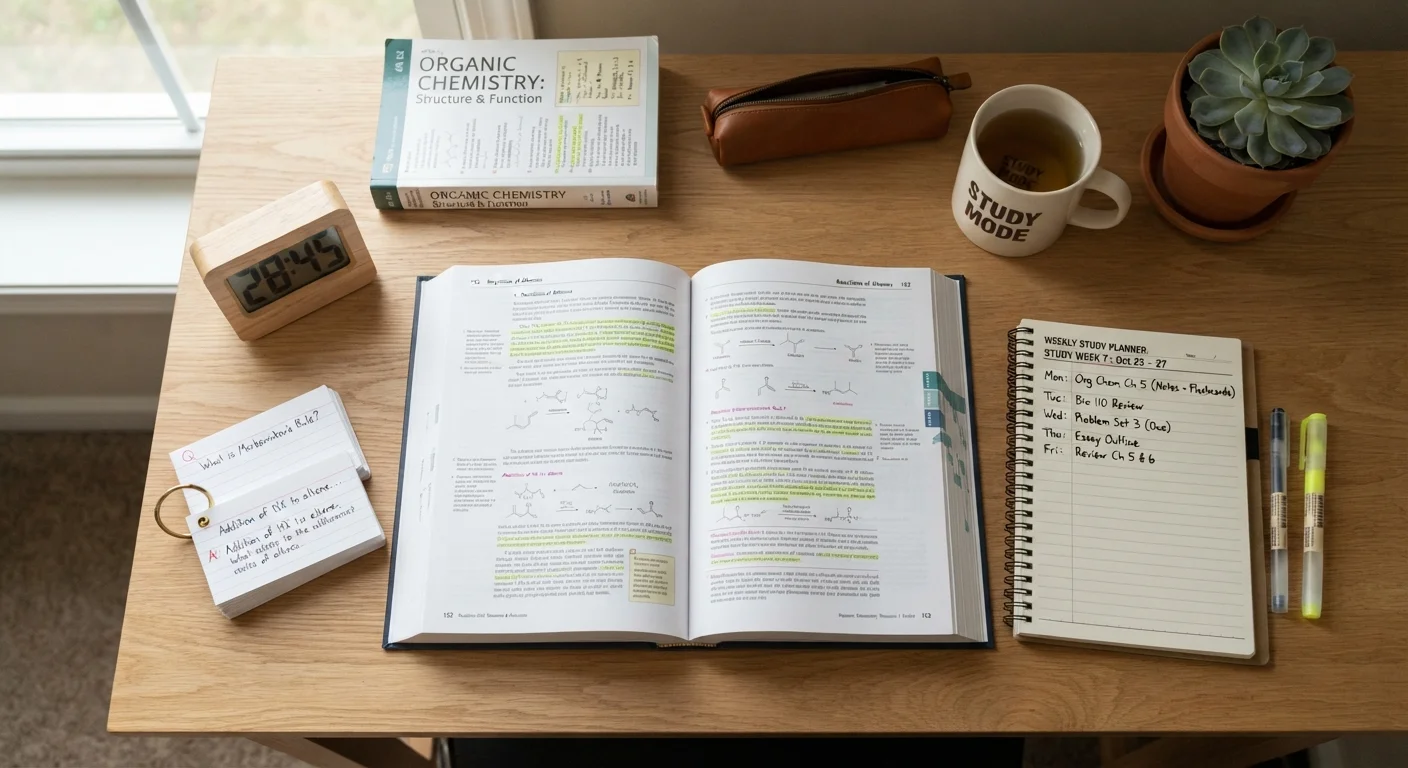
Picking a method is just the first step. The real value comes from consistent use and regular review. Whichever system you choose, schedule a short review session within 24 hours of taking notes - this is when the material is still partially active in memory and consolidation is most efficient. For a deeper look at how spacing and retrieval interact with that process, see spacing, retrieval, and interleaving techniques grounded in cognitive research.
Mix Methods Across Subjects
You don't have to commit to a single note-taking system for everything you study. Many experienced learners use the Cornell method for lecture-based courses, mind maps for brainstorming and topic exploration, and charting for vocabulary-heavy or comparative content. Matching your method to the material - rather than using one approach by habit - is a simple shift that can meaningfully improve how well you process and retain new information.
Note-taking also works best when it's part of a broader learning structure. If you haven't already mapped out your study goals and review schedule, setting up a learning plan you'll actually follow offers a practical checklist to get started. Good notes deserve a good system around them.