
Why the Question Is Harder Than It Looks
A bonus, tax refund, or pay raise creates a genuine fork in the road. Financial advice often frames it as a binary-pay off debt or save-but the real answer depends on a set of overlapping variables: the interest rate on your debt, whether your savings will earn a return that competes with that rate, tax treatment on both sides, and how exposed you are to financial disruption if something goes wrong.
The core tension is mathematical. Every dollar used to pay down a 22% APR credit card generates a guaranteed 22% return in avoided interest. Savings, by contrast, are never guaranteed. That said, ignoring savings entirely while attacking debt can leave you vulnerable-one car repair or medical bill can push you straight back onto a credit card, undoing weeks of progress.
For a structured way to split limited income between these two goals, see our realistic framework for doing both at once.
The Interest Rate Test: When Debt Payoff Wins Clearly
The most reliable starting point is comparing your debt's interest rate to what your savings can realistically earn. High-yield savings accounts and low-risk investments typically yield returns that vary with market conditions-and they're not guaranteed. When your debt carries an interest rate meaningfully above what savings can earn, the math generally favors payoff.
A practical threshold many financial educators reference is roughly 6-7%. Debt above that range is difficult for most savings vehicles to outperform on a risk-adjusted basis. Credit card debt, which often carries rates of 18-25% APR, falls firmly in this category. Personal loans and retail store cards frequently do as well.
| High-Interest Debt Payoff | Emergency Savings | Retirement Contributions | Low-Interest Debt Payoff | |
|---|---|---|---|---|
| Typical return/benefit | 18-25% in avoided interest | Prevents costly debt relapse | Match = 50-100% instant return | 3-6% in avoided interest |
| Risk level | None - guaranteed benefit | None - liquid cushion | Market-dependent after match | None - guaranteed benefit |
| Tax advantage | None | None (taxable account) | Pre-tax or Roth growth | Mortgage interest may be deductible |
| Liquidity impact | Reduces monthly minimum burden | Improves short-term resilience | Locked until retirement (generally) | Reduces long-term cost |
| Best priority stage | After emergency fund | First priority | Second (up to match) | Last in sequence |
Lower-rate debt, such as federal student loans or a fixed-rate mortgage, sits in a grayer zone. Here, the interest rate difference between debt and savings may be small enough that other factors-tax deductibility, investment time horizon, liquidity-matter more than the spread alone. For context on how debt payoff strategies compare within that category, our guide to debt avalanche vs. debt snowball breaks down the approaches in detail.
When Saving Should Come First (or at Least Alongside Debt)
Two situations almost always justify prioritizing savings even when debt exists: the absence of an emergency fund, and an unclaimed employer retirement match.
Emergency fund: Without a cash cushion, any unexpected expense becomes a debt event. Most personal finance guidance suggests keeping at least $500-$1,000 accessible before making extra debt payments-enough to cover a common disruption without reaching for a credit card. Our article on building an emergency fund while carrying debt walks through how to approach both simultaneously.
Employer 401(k) match: If your employer matches contributions you're not yet making, every unmatched dollar is a 50-100% return you're forgoing. No debt interest rate competes with that. Contributing enough to capture the full match is widely considered one of the highest-value financial moves available to employed workers.
Automate the Split to Stay Consistent
If you decide to direct extra income toward both savings and debt, automation reduces the risk of spending it before it reaches either goal. Set up automatic transfers to a savings account and an extra debt payment on the same day your paycheck arrives. Even a modest, consistent split-say, 60% toward high-interest debt and 40% toward emergency savings-builds both simultaneously without requiring constant willpower or manual transfers.
Beyond those two anchors, tax-advantaged savings accounts-traditional IRAs, Roth IRAs, HSAs-offer deductions or tax-free growth that can shift the effective cost comparison between saving and debt repayment. Consult a qualified financial professional to assess how these apply to your specific situation.
A Tiered Approach That Works for Most Situations
Rather than choosing one goal entirely, most people benefit from a sequenced framework that addresses the highest-priority needs first before moving down the list:
- Build a minimal emergency fund ($500-$1,000) to prevent debt relapse from routine disruptions.
- Capture any employer retirement match in full-this is a guaranteed return with no meaningful downside.
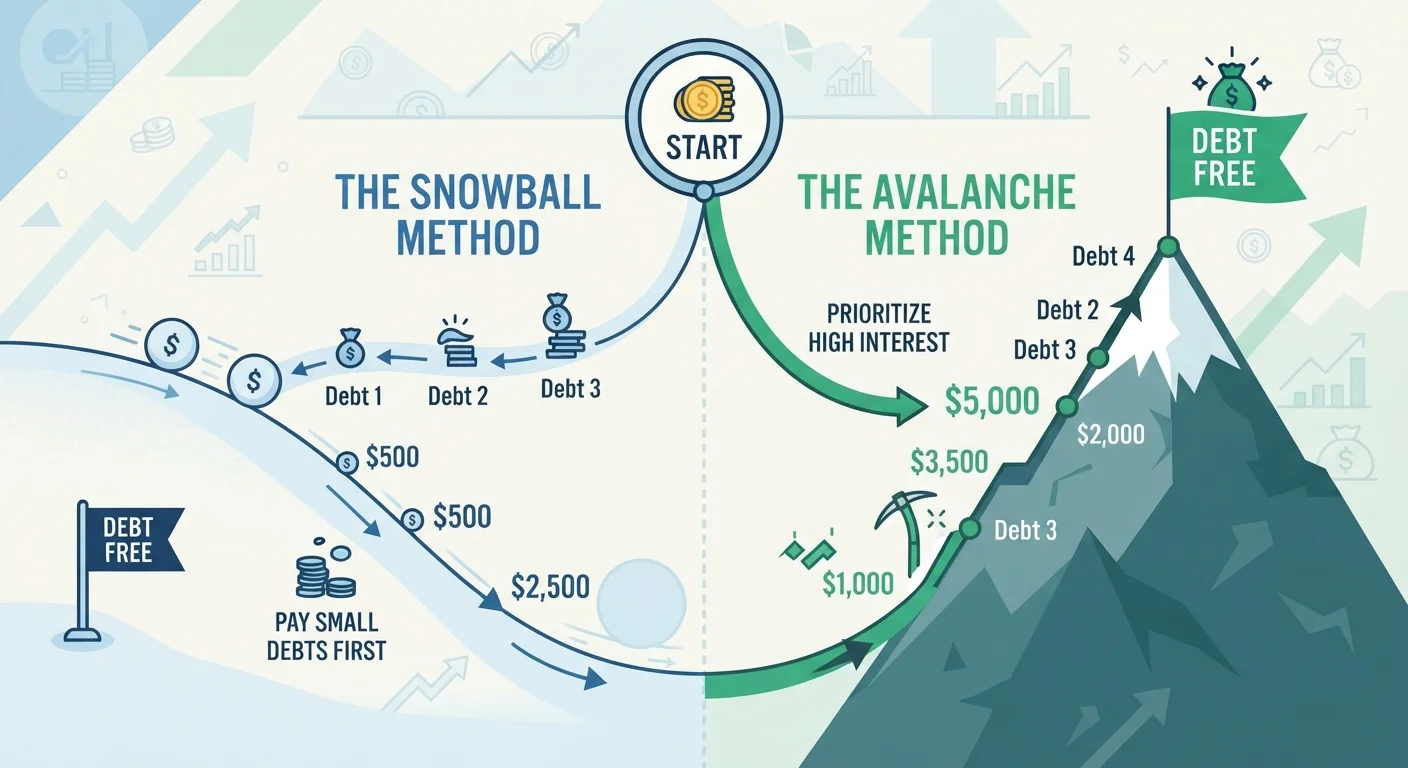
- Pay down high-interest debt (generally above 6-7%) aggressively, using methods that fit your psychology-whether that's avalanche or snowball ordering.
- Expand emergency savings toward a fuller 3-6 month cushion, especially if your income is variable or your job is less stable.
- Split remaining extra dollars between long-term savings goals (retirement, investment accounts) and any remaining lower-rate debt.
This isn't a rigid prescription-it's a general ordering principle. Your specific debt rates, account options, and income stability may shift the sequence. The pay yourself first principle pairs well with this structure, automating savings contributions before discretionary spending gets a chance to absorb them.
This article is for general informational and educational purposes only and does not constitute personalized financial, investment, or tax advice. Consult a licensed financial professional before making decisions based on your individual circumstances.