
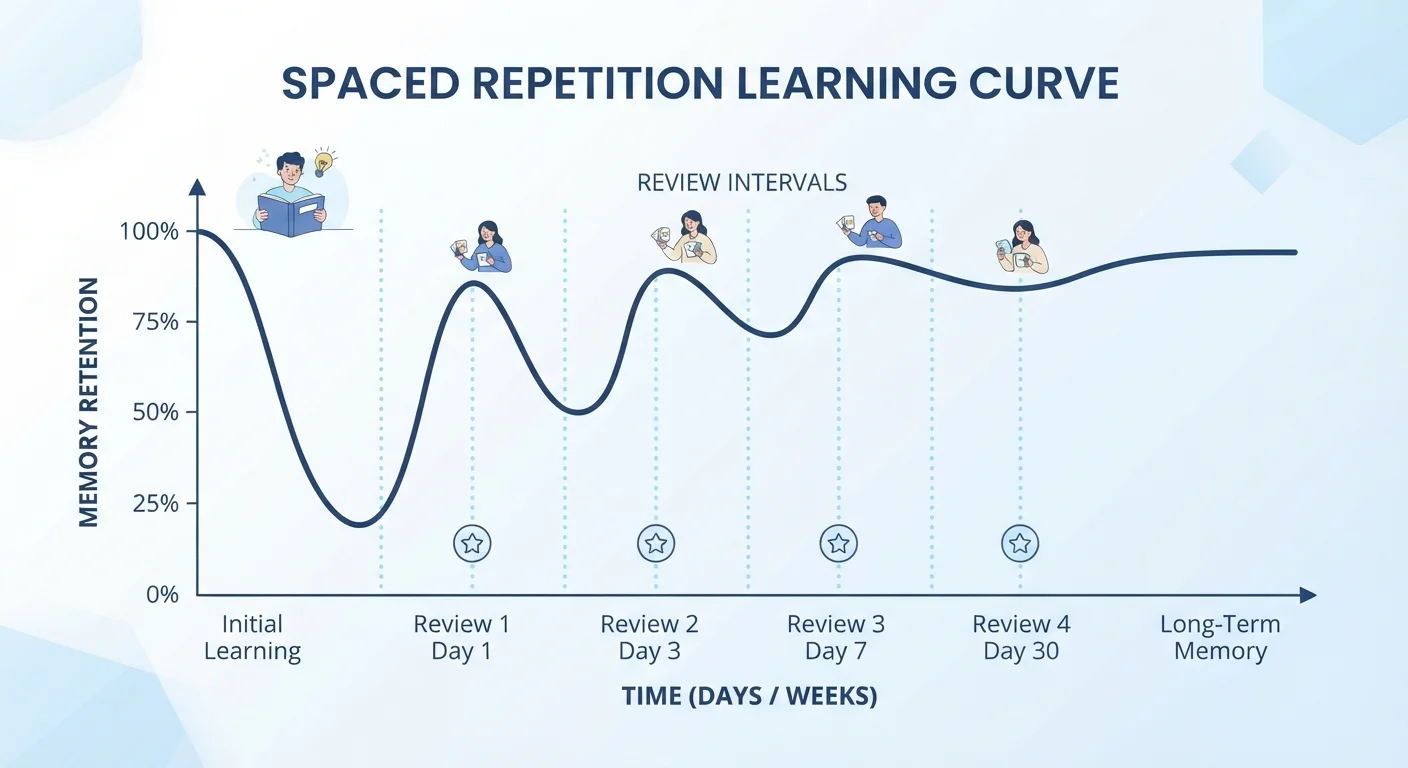
What the Research Actually Shows
The spacing effect - the finding that spreading study sessions over time produces better retention than cramming - has been replicated in research for well over a century. Hermann Ebbinghaus documented the forgetting curve in the 1880s, showing memory drops sharply without review. Decades of follow-up research in cognitive psychology has confirmed that strategic, timed review dramatically slows that decline.
A landmark review published in Psychological Science in the Public Interest (Dunlosky et al., 2013) rated spaced practice as one of the highest-utility study strategies available, noting that its benefits have been demonstrated across a wide range of ages, subjects, and learning conditions. Unlike many popular study beliefs, spaced repetition holds up under controlled experimental conditions. For a broader look at which common methods don't hold up, see study myths the research has debunked.
High utility
Evidence rating for spaced practice
Dunlosky et al. (2013) in Psychological Science in the Public Interest rated spaced practice among the highest-utility study strategies based on a comprehensive review of the learning literature.
~50%
Memory lost within one hour without review
Based on Ebbinghaus's forgetting curve research, roughly half of new information may be forgotten within an hour of learning if no review occurs - a rate that spaced repetition is specifically designed to counteract.
130+ years
Research history behind the spacing effect
The spacing effect has been studied since Ebbinghaus's foundational memory experiments in the 1880s, making it one of the most durable findings in cognitive psychology.
How Memory Consolidation Makes It Work
Every time you successfully retrieve a piece of information, the underlying memory trace becomes stronger - a process known as retrieval practice or the testing effect. Spaced repetition is powerful precisely because it forces you to retrieve information repeatedly, but always after enough time has passed that the memory has weakened slightly. That struggle to recall - and the successful retrieval that follows - is what deepens the memory.
This stands in direct contrast to passive review methods like rereading notes. Rereading feels productive because the material looks familiar, but familiarity isn't the same as recall. Active recall outperforms passive review precisely because it engages the retrieval mechanism that spaced repetition relies on.
“Of all the variables that influence learning, retrieval practice - being tested on material - is among the most powerful. And the benefits are amplified when that practice is distributed across time rather than massed into a single session.”
— Henry L. Roediger III, Memory researcher, Washington University in St. Louis, known for work on the testing effect and retrieval practice
Putting Spaced Repetition Into Practice
The simplest manual approach uses a small stack of flashcards divided into groups. Cards you answer correctly move to a pile reviewed less frequently; cards you miss return to a pile reviewed daily. Over time, well-known cards are reviewed less often while difficult ones stay in frequent rotation. This basic structure mirrors the logic of more sophisticated algorithmic systems.
If you prefer a structured approach to organizing your review sessions within a broader schedule, building a study schedule that you'll actually stick to offers a practical framework for doing exactly that. The key is consistent, short sessions distributed across days and weeks - not occasional long marathons.
Start Small to Build the Habit
New spaced repetition users often try to review too many cards at once, which leads to overwhelming backlogs and abandoned sessions. Start with no more than 10-15 new items per day, keeping daily review under 20 minutes. Consistency over weeks matters far more than volume in any single session.
For adult learners applying these ideas in professional contexts, the principles translate directly. Evidence-informed study habits for adult learners explores how these techniques apply to continuing education and career development. And for a broader overview of the related strategies - including interleaving and retrieval practice - spacing, retrieval, and interleaving techniques backed by cognitive research provides useful context.