What Each Path Actually Offers
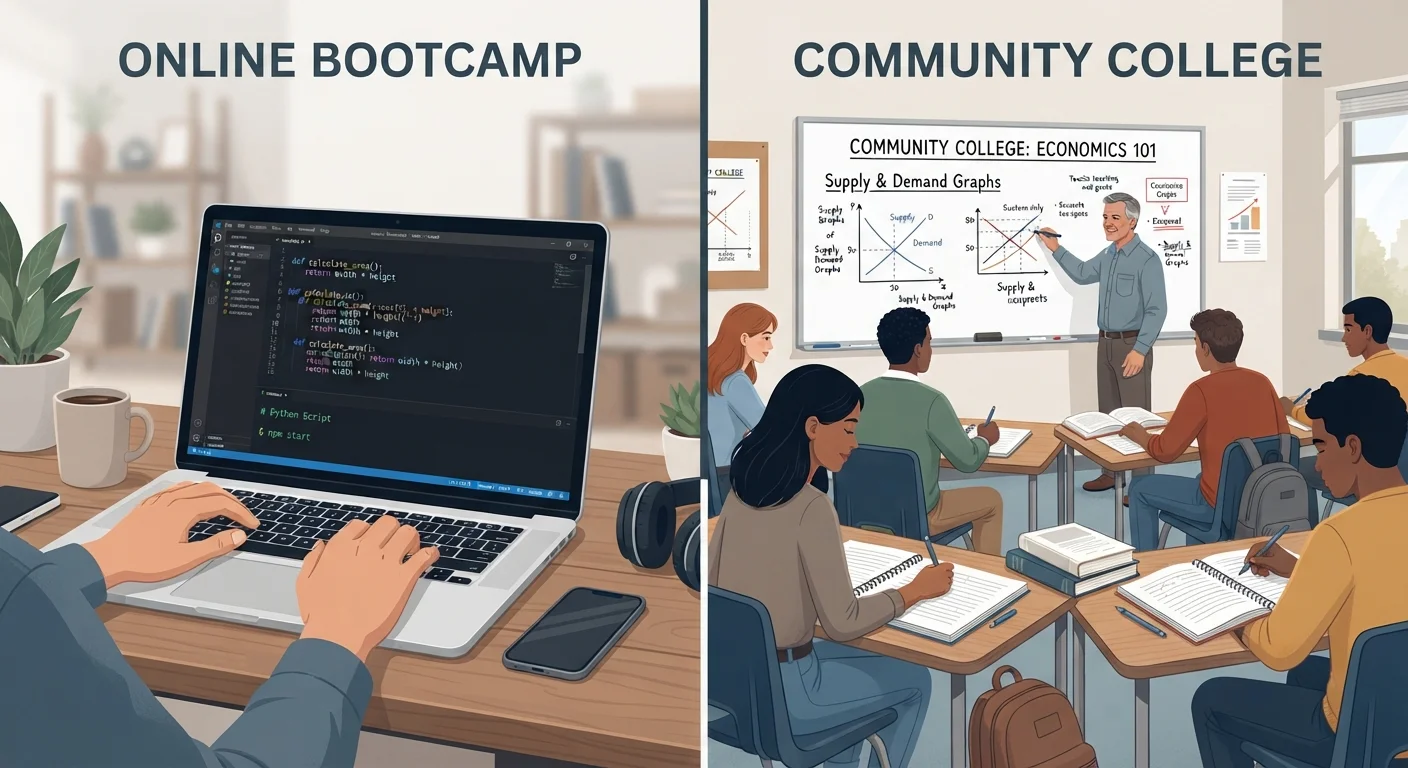
An online bootcamp is a privately operated, intensive training program - typically 8 to 24 weeks - focused on a narrow, in-demand skill set such as software engineering, data analytics, cybersecurity, or UX design. Instruction is often project-based, and programs may include career coaching or employer networking as part of their model. Bootcamps are not degree-granting institutions and are generally not regionally accredited, though some have pursued other forms of quality recognition.
A community college certificate is a credential awarded by a publicly funded, regionally accredited two-year institution after a student completes a defined sequence of courses - typically 12 to 30 credit hours. Certificate programs span fields from healthcare and information technology to business administration and skilled trades. Because community colleges hold regional accreditation, their credentials are widely recognized by employers and are eligible to stack toward associate degrees.
Understanding how employers read these credentials matters as much as the programs themselves. See our guide on how employers interpret credentials for context before committing to either path.
Cost, Time, and Access Compared
| Criterion | Online Bootcamp | Community College Certificate |
|---|---|---|
| Typical duration | 8-24 weeks | 1-2 semesters (varies) |
| Accreditation | Generally not regionally accredited | Regionally accredited institution |
| Federal financial aid eligible | Typically no | Yes |
| Cost range (approximate) | $5,000-$20,000+ | $1,500-$8,000 (in-state) |
| Credit transferability | Rarely transferable | Often applies toward a degree |
| Schedule format | Intensive, often asynchronous | Semester-based, structured |
| Best-recognized sectors | Tech, design, data | Most industries, regulated fields |
Cost is one of the sharpest contrasts between these two paths. Community college certificate programs are typically priced per credit hour and vary by state residency, but in-state tuition is generally far lower than bootcamp tuition. Crucially, community college students may qualify for federal Pell Grants, institutional scholarships, and employer tuition reimbursement programs - substantially reducing out-of-pocket cost.
Bootcamp pricing varies considerably by program and format. Some programs have moved toward income share agreements (ISAs), where students pay a percentage of future income after landing a job. However, ISAs carry their own financial risks and terms that merit careful review. Most bootcamps do not qualify for federal financial aid.
Time commitment also differs in structure rather than just length. Bootcamps demand focused, often daily engagement over a compressed window. Community college certificates proceed on a semester calendar, which can feel slower but allows learners to balance coursework with other responsibilities over a longer horizon.
~$3,800
Avg. annual in-state community college tuition (U.S.)
According to the College Board's Trends in College Pricing report, average in-state community college tuition and fees are substantially lower than four-year institutions.
17 weeks
Median bootcamp program length
Course Report's annual bootcamp market sizing study has consistently found the median full-time bootcamp runs approximately 14-17 weeks.
Employer Recognition and Career Outcomes
Employer perception of bootcamp credentials has shifted meaningfully over the past decade - particularly in technology sectors - but it remains uneven. Hiring managers in software engineering, data science, and UX roles at many tech-forward companies have grown familiar with bootcamp graduates and evaluate them on portfolio work and demonstrated skills rather than institution name. In more regulated industries (healthcare, finance, education), institutional accreditation carries more weight, giving community college certificates an advantage.
It is important to note that neither credential guarantees a job offer. Outcomes depend on the local labor market, the field in question, the quality of the program, and - critically - the learner's effort in applying skills and networking. Be cautious of any program that presents employment statistics without clearly explaining how those figures were calculated and who was included.
If you are thinking strategically about long-term credential-building, community college certificates can serve as the foundation of a stackable credentials pathway that builds toward greater qualifications over time.
Choosing the Right Fit for Your Situation
The better path depends on three core factors: your target field, your financial position, and how you learn best.
If you are pivoting into a tech-adjacent role and have the financial means to self-fund or accept a bootcamp's financing arrangement, a well-regarded bootcamp can compress your timeline to employment significantly. If your goal field values institutional credentials - or if you anticipate continuing toward a degree - a community college certificate offers durability and optionality that most bootcamps cannot match.
Consider also your learning environment preferences. Bootcamps reward self-direction and thrive-under-pressure mindsets. Community college programs offer more scaffolding, instructor office hours, and a structured syllabus pace. Neither is inherently superior - they reflect different learner needs. For a broader look at how these formats fit into different life circumstances, our comparison of formal courses, self-study, and mentorship offers useful framing.
Before enrolling in either program, verify what completing it actually positions you for. A credential that produces skills but no clear next step is a common pitfall - one explored in depth in our article on where professional development goes wrong.
Researching Program Quality Before You Enroll
For bootcamps, look for programs that publish audited outcomes data - including graduation rates and the methodology behind job placement figures. For community college certificates, confirm whether credits are accepted by four-year institutions in your state if you anticipate transferring. The U.S. Department of Education's College Navigator tool can help verify a community college's accreditation status. For bootcamps, check whether the program holds any state authorization or voluntary quality recognition from bodies like ACCET.