
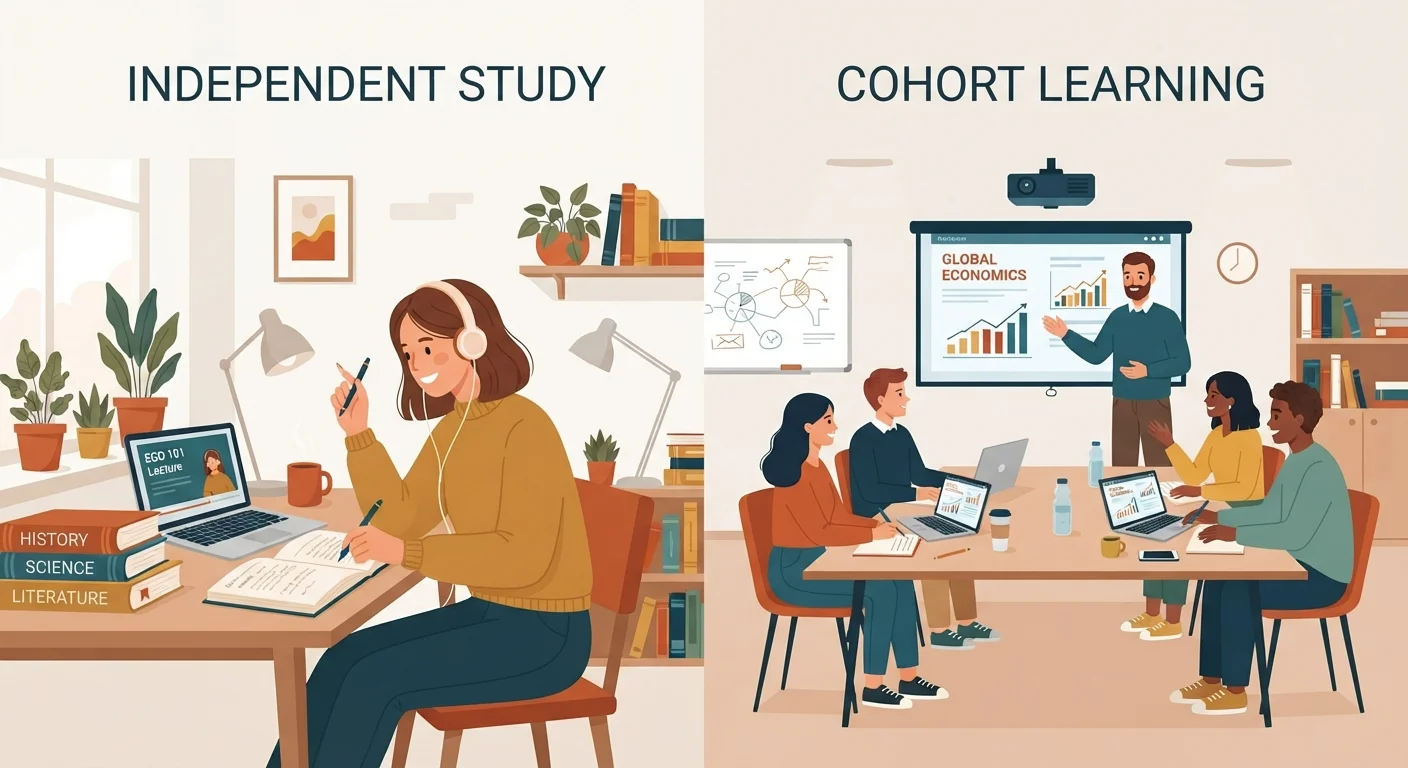
What Each Approach Actually Means
Self-directed learning means you control what you study, when you study it, and how you measure progress. Resources can include books, free open courseware, podcasts, YouTube tutorials, or articles - whatever fits your goal. There is no enrollment, no instructor, and typically no credential at the end.
Structured programs cover a broad spectrum: community college courses, employer-sponsored training, professional certification programs, and university degrees. What they share is externally designed curriculum, set timelines, and some form of assessment or credential.
Understanding the difference matters because the right format for learning data analysis may not be the right format for brushing up on writing skills. For a fuller picture of how these formats compare to mentorship as a third option, see Formal Courses, Self-Study, or Mentorship.
Advantages and Disadvantages at a Glance
Both approaches have genuine strengths - and genuine weaknesses that advocates often downplay. The lists below reflect real patterns reported by adult learners and supported by research on self-regulation and learning outcomes.
Schedule and pace are entirely your own
You can study at 6 a.m. or on a lunch break, speeding through familiar material and slowing down where you need depth. This flexibility is especially valuable for working adults with unpredictable schedules.
Lower cost than most formal programs
Many self-directed resources - library books, open courseware, free tutorials - carry no tuition cost. Even paid resources like individual online courses are typically a fraction of degree or certificate program fees.
Curriculum tailored to your exact goal
You choose what to study and skip what is irrelevant, avoiding the general-education requirements that structured programs often include regardless of your specific career target.
Immediate application to current work
You can learn something Monday and apply it to a real project Tuesday, rather than waiting for a semester to end before the knowledge becomes practically useful.
No external accountability to keep you going
Without deadlines, enrollment fees, or instructor check-ins, self-directed study is easily deprioritized when work or life demands increase. Research on self-regulated learning consistently identifies this as the leading cause of incomplete self-study efforts.
No formal credential for employers or licensing bodies
In fields where credentials are used as hiring filters, self-directed learning alone may not satisfy recruiter requirements, regardless of actual competence gained.
Risk of gaps and misconceptions going undetected
Without an instructor or structured assessment, learners may not realize when they've misunderstood a concept or skipped a foundational piece that would affect later learning.
Limited peer interaction and professional networking
Much of the value of formal programs comes from cohort relationships that can support job searches and collaboration for years. Solo study provides little equivalent.
One nuance worth noting: the disadvantages of self-directed learning are not fixed. Learners who build deliberate routines and engage with a learning community can offset many of the accountability gaps that derail solo study.
When Self-Directed Learning Has the Edge
Self-directed learning tends to outperform structured programs in specific circumstances:
- When the skill is practical and testable. If you can demonstrate competence through a portfolio, open-source contributions, or a work project, the absence of a certificate matters less.
- When speed is critical. A motivated learner can often cover specific job-relevant material faster outside a semester-length format.
- When budget is tight. Public libraries, open courseware from universities, and free and low-cost resources can make self-directed study nearly cost-free.
- When the goal is exploratory. Curiosity-driven learning - exploring history, philosophy, or creative writing for personal growth - rarely needs external validation.
~6%
Completion rate for many open online courses
Research published in academic journals on MOOC completion rates consistently finds that fewer than 10% of enrolled learners finish most open online courses, illustrating the accountability gap in self-paced formats.
74%
Adults who say continuous learning is career-essential
A Pew Research Center survey on work and learning found that a large majority of working adults view ongoing skill development as essential to their career success.
When Structured Programs Have the Edge
Structured programs tend to be the stronger choice in these situations:
- When credentials are gatekeeping entry. Certain fields - nursing, accounting, engineering, law - require licensed or accredited qualifications that self-study alone cannot confer.
- When you need expert feedback. Writing, design, and other craft-based skills often develop faster when a knowledgeable instructor or peer cohort responds to your actual work.
- When your self-discipline is inconsistent. External deadlines and financial stakes raise the cost of procrastination in ways that free resources cannot replicate.
- When networking matters. Cohort-based programs create professional connections that solo study does not.
Credentials Vary Widely in Employer Recognition
Not all structured programs produce equally valued credentials. A certificate from a regionally accredited institution generally carries more weight with employers than one from an unaccredited provider. Before enrolling, research how employers in your target field view the specific credential you would earn - industry associations and job postings can be useful reference points. This is general information; individual employer practices vary significantly.
If you're weighing a platform-based middle path - MOOCs or subscription video libraries - Online Learning Platforms: What to Weigh Before Committing Your Time lays out the key factors to consider.
Building a Hybrid Strategy That Works
Most adult learners don't need to choose one model exclusively. A realistic hybrid might look like this: complete a short structured course to gain foundational knowledge and a verifiable credential, then use self-directed study to explore adjacent topics, stay current, or go deeper on areas that matter most for your specific role.
The key is designing that self-directed portion intentionally. Without a plan, unstructured time easily drifts. The Setting Up a Learning Plan You'll Actually Follow guide offers a structured checklist for defining goals, choosing format, and tracking progress. Pairing that with guidance on building a personal learning habit helps ensure the plan doesn't stall after the first week.
The goal is not to find the objectively superior method - it's to find the method that fits your actual life and moves you toward a concrete outcome.