The Myth That Learning Peaks in Youth
Many adults carry a quiet assumption that their best learning years are behind them - that somewhere around their mid-twenties, the brain's plasticity solidified and the window for absorbing new knowledge narrowed to a crack. This belief is not only inaccurate; it's actively counterproductive.
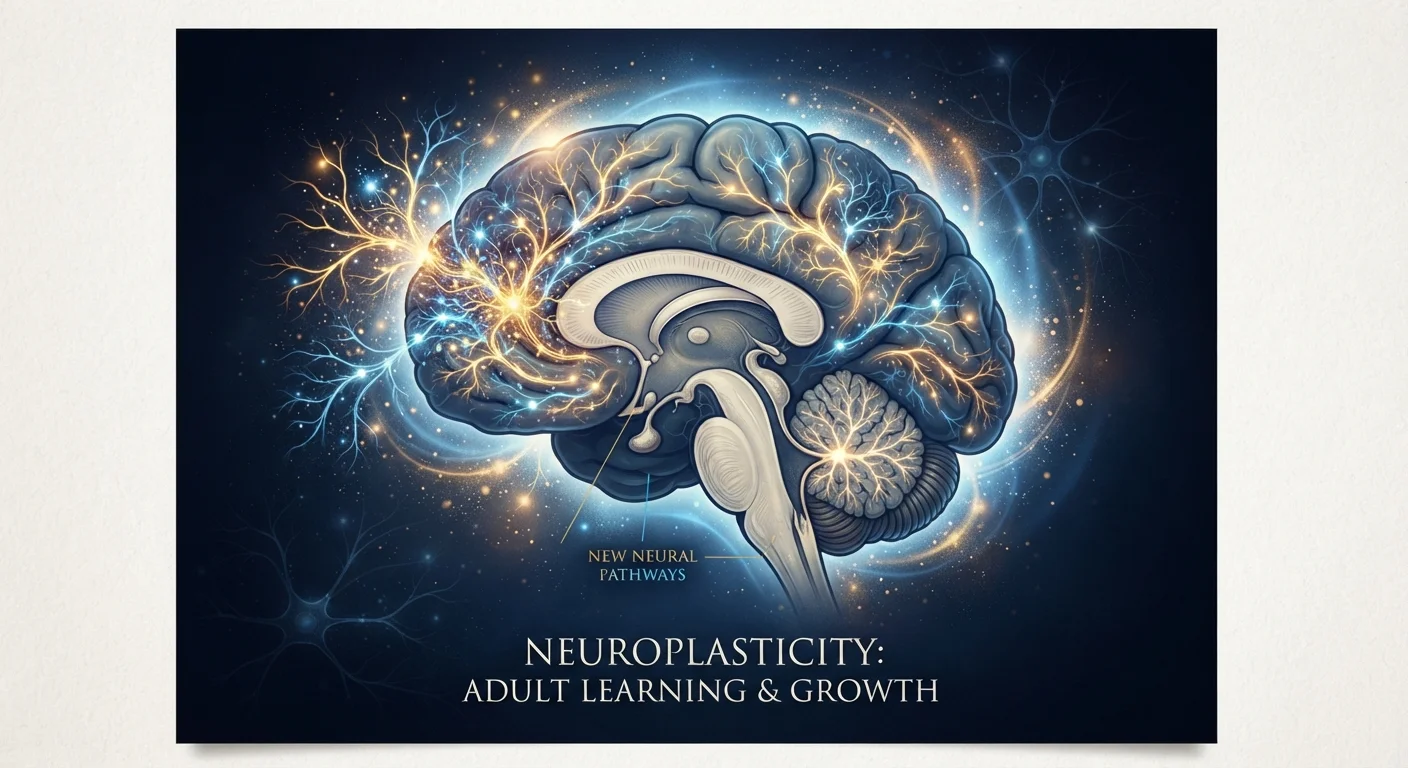
Decades of neuroscience research have established that the adult brain retains a remarkable capacity for structural and functional change throughout life. This property - neuroplasticity - refers to the brain's ability to reorganize neural pathways in response to new experiences, information, and challenges. It doesn't switch off at 25 or 40 or 60.
Understanding what the science actually says - and separating it from persistent myths - is the first step toward becoming a more confident, effective adult learner. For a fuller picture of what this means in practice, see what lifelong learning actually means.
Myth
The brain stops forming new connections after early adulthood, making it much harder to learn anything truly new.
Fact
The brain continues forming new neural connections - a process called synaptic plasticity - throughout the entire lifespan.
Research using neuroimaging has shown that adult brains exposed to new challenges - learning an instrument, acquiring a language, mastering a trade - demonstrate measurable structural changes, including increased gray matter density in relevant regions. Neurogenesis (the formation of new neurons) has been observed in the hippocampus, a region central to memory formation, in adults of all ages. The rate of change may differ from childhood, but the capacity itself does not disappear.
Myth
If you haven't learned something by your twenties, you've missed the critical window - some things just can't be picked up later.
Fact
"Critical periods" are specific to early sensory development (like vision); the vast majority of skills and knowledge domains remain fully learnable throughout adulthood.
Critical periods - windows during which specific neural systems require certain inputs to develop normally - exist for functions like binocular vision and native-language phonology. But they are narrow biological exceptions, not a general rule. Adults routinely achieve fluency in second languages, develop musical skill, learn complex professional disciplines, and master athletic techniques with focused, well-structured effort. The timeline may look different than childhood acquisition, but the outcome is genuinely attainable.
Myth
Older adults can't retain new information as well because their memory is simply declining.
Fact
Age-related changes in memory are real but highly specific - and many forms of memory and learning remain strong or even improve across adulthood.
Working memory capacity and processing speed show modest declines with age, but long-term semantic memory (knowledge of facts and concepts), procedural memory (how to do things), and episodic memory for emotionally significant events tend to remain robust. Crucially, adults who engage in regular mentally stimulating activity show slower cognitive aging. The brain is not a fixed container that gradually empties - it is a dynamic system shaped by how it is used.
Myth
Learning difficulty in adulthood is mainly a sign of lower intelligence or diminishing mental capacity.
Fact
Most adult learning difficulty stems from modifiable factors - stress, poor sleep, ineffective study methods, or fixed mindset - not declining intelligence.
When adults struggle to learn, the cause is rarely biology. Chronic stress elevates cortisol, which impairs hippocampal function and memory encoding. Sleep deprivation disrupts consolidation. Using ineffective learning strategies (like passive re-reading) produces an illusion of learning without durable retention. And a fixed mindset - the belief that ability is innate rather than developed - causes adults to disengage when things get hard. Each of these factors is addressable with the right awareness and habits.
Myth
Children learn languages effortlessly, so adults who struggle with a second language are simply at a permanent disadvantage.
Fact
Adults and children learn languages differently, with adults holding several genuine advantages in grammar acquisition, vocabulary building, and strategic learning.
Children have the advantage of extended immersion and social motivation for first-language acquisition. But research suggests adults often reach grammatical accuracy faster in structured instruction settings, because they can leverage existing linguistic knowledge and apply deliberate learning strategies. Adult accent acquisition may be harder due to phonological entrenchment, but communicative competence - the practical ability to use a language - is fully achievable. Many adults reach high proficiency with consistent, well-structured practice.
What Adult Brains Do Better
While some cognitive functions - such as raw processing speed and working memory capacity - do shift with age, adult brains compensate with qualities that can make learning more effective, not less.
40s-60s
Peak range for crystallized intelligence
Research published in cognitive aging literature suggests vocabulary and accumulated knowledge tend to peak between a person's forties and sixties, not in youth.
~20%
Reduction in cognitive decline risk with active learning
Studies on cognitively stimulating activity suggest regular learning engagement is associated with meaningfully lower rates of age-related cognitive decline, though individual results vary.
Crystallized intelligence - the accumulated store of knowledge, vocabulary, and conceptual frameworks - tends to grow across adulthood. This gives adult learners a richer scaffolding onto which new information can attach. A 45-year-old learning financial modeling, for instance, brings decades of contextual understanding about money, organizations, and risk that a 20-year-old student simply hasn't accumulated yet.
Adults are also generally better at self-regulated learning: setting goals, monitoring their own understanding, and adjusting strategies when something isn't working. These metacognitive skills are among the strongest predictors of learning success - and they tend to improve with age and experience. Explore how those skills apply to professional growth in the Career Learning hub.
That said, adults often face real obstacles: time pressure, competing responsibilities, and sometimes a fixed mindset shaped by past educational experiences. Recognizing those barriers - rather than attributing them to biology - is essential. Why capable adults stop learning explores the psychological patterns that quietly close off growth.
Don't Confuse Ineffective Methods With an Aging Brain
Many adults who feel they "can't learn like they used to" are actually using the same passive study habits from school that were never that effective to begin with. Rereading, highlighting, and marathon cramming sessions produce weak retention at any age. Switching to evidence-based techniques often reveals that the brain was never the problem.
How to Work With Your Adult Brain
Knowing that the adult brain can learn is only useful if you apply the right conditions. Research in cognitive psychology consistently points to a handful of practices that dramatically improve retention and skill acquisition for adult learners.
Spaced repetition - reviewing material at increasing intervals rather than cramming - exploits how long-term memory consolidation actually works. Retrieval practice (actively recalling information rather than re-reading it) strengthens memory traces far more effectively than passive review. Interleaving different topics or problem types during a study session, though it feels harder in the moment, produces more durable learning. A deeper look at these methods is available in our guide to spacing, retrieval, and interleaving.
Sleep is non-negotiable. Memory consolidation - the process by which the brain stabilizes newly learned information - occurs primarily during sleep. Consistent sleep deprivation doesn't just make you tired; it actively impairs the brain's ability to encode and retain new material.
Finally, connecting new learning to existing knowledge and to personal goals accelerates acquisition. Adults who understand why something matters and how it fits into what they already know learn faster and retain more. If you're ready to put these principles into a structured practice, The Lifelong Learner's Complete Roadmap offers a comprehensive framework. And if you're navigating a specific new skill in mid-life, what to expect when learning after 40 offers honest, practical guidance.