
What Lifelong Learning Actually Means
Lifelong learning is the ongoing, self-motivated pursuit of knowledge and skills beyond formal schooling. It isn't a personality type reserved for academics or overachievers - it's a practice anyone can develop, regardless of age, background, or prior education. The core idea is simple: you keep growing deliberately, not just by accident of circumstance.
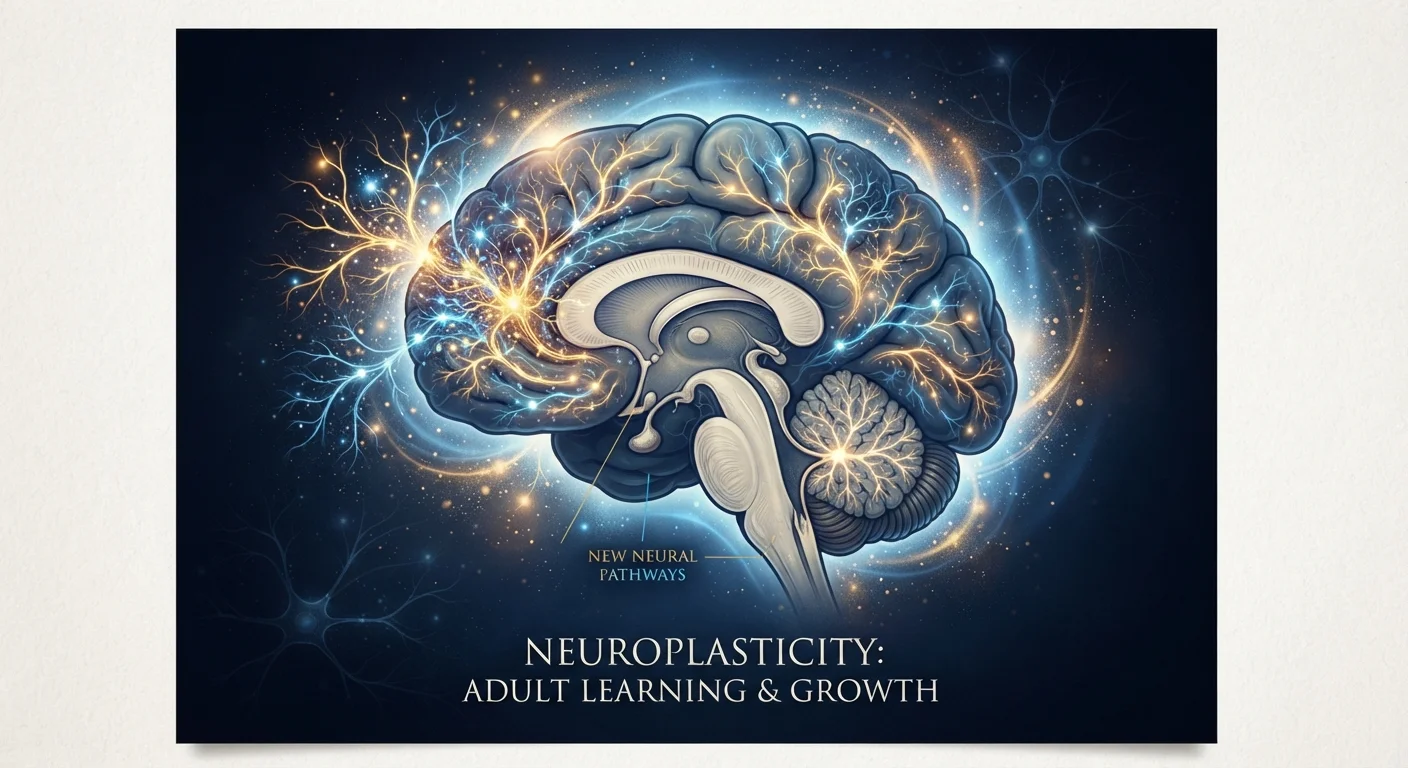
Research in cognitive neuroscience consistently shows that adult brains maintain significant plasticity - the ability to form new neural connections - well into later life. Understanding how adult brains learn can shift the way you approach your own development, dissolving the myth that learning gets harder or less effective after a certain age.
What separates intentional lifelong learners from passive ones is structure. Curiosity provides the spark, but habits, tools, and community provide the fuel for lasting growth.
74%
Adults who consider themselves lifelong learners
According to Pew Research Center survey data on learning and personal development among U.S. adults.
5 hours
Weekly self-directed learning among many professionals
Commonly referenced as the 'five-hour rule' - a pattern observed among high-performing professionals who dedicate structured time to deliberate learning.
10-30%
Improvement in retention from active recall vs. re-reading
Meta-analyses in cognitive psychology consistently show retrieval practice produces substantially stronger long-term memory than passive review.
Building Your Learning Foundation
Before diving into specific subjects, effective learners establish a foundation: a sense of why they're learning, a realistic picture of the time they have, and a basic system for capturing and reviewing what they encounter.
Define Your Learning Goals
Broad goals like "learn more about history" tend to stall. Concrete goals - "understand the economic causes of World War I well enough to explain them to someone else" - give you a finish line. A written learning plan, even a simple one, turns vague intention into a workable schedule. See how to set up a learning plan you'll actually follow for a structured starting framework.
Create a Capture System
Ideas, articles, and insights encountered throughout a day evaporate quickly without a reliable capture system. Whether you use a paper notebook, a digital notes app, or index cards, the habit of writing down what you notice - and periodically reviewing it - transforms passive exposure into retained knowledge.
Tie new learning sessions to an existing daily habit - morning coffee, a lunch break, or an evening wind-down - rather than relying on finding extra time.
Habit stacking, a concept grounded in behavioral science, dramatically reduces the friction of starting and increases consistency over weeks and months.
After any reading or lesson, write two or three sentences summarizing the most surprising or useful idea without looking at your notes.
This form of free recall - retrieving information from memory under mild challenge - is one of the most robust retention strategies identified in cognitive research.
Choosing the Right Learning Path
Not all learning formats suit all goals or lifestyles. Formal courses offer structure, accountability, and often credentials. Self-study offers flexibility and self-direction. Mentorship accelerates skill-building through personalized feedback and pattern recognition that books rarely provide.
Most serious learners use a blend. A working adult might take one structured online course per quarter for credential-building, read independently on adjacent topics, and seek a mentor for career-specific guidance. Comparing formal courses, self-study, and mentorship can help you identify which mix fits your current goals and constraints.
Match the Format to the Goal
If you need accountability and a credential, a structured course usually wins. If you need flexibility and broad exploration, self-directed reading is more efficient. Mixing formats based on your current goal - rather than defaulting to one approach - keeps learning sustainable. Reassess your format every quarter as your goals evolve.
If you're building career-relevant skills, consider whether a credential matters to your field. For many professional domains, demonstrated competency - through a portfolio or project - carries more weight than a certificate alone.
Moving from Broad Curiosity to Deep Expertise
There's a productive tension between reading widely - exploring many subjects - and reading deeply, building genuine expertise in one area. Neither approach is universally superior. Early in a learning journey, breadth helps you discover what genuinely engages you. Once you've identified a high-value domain, depth compounds your understanding in ways that surface-level exposure never can.
Exploring the trade-offs between depth and breadth is worthwhile before committing heavily to either strategy. A practical heuristic: spend the first stage of learning a subject broadly, then narrow deliberately once you can identify the questions that genuinely interest you most.
Deep expertise also develops through application - not just study. Teaching a concept, writing about it, debating it, or using it in a real project are all more effective consolidation strategies than re-reading alone. Academic skill-building resources cover many of the retrieval and elaboration techniques that learning science endorses.
“The illiterate of the 21st century will not be those who cannot read and write, but those who cannot learn, unlearn, and relearn.”
— Alvin Toffler, Futurist and author of 'Future Shock'
Sustaining Momentum Over Decades
The central challenge of lifelong learning isn't getting started - it's sustaining the practice when motivation dips, schedules get crowded, or a subject proves harder than expected. Several evidence-informed approaches help.
- Protect small time blocks. Thirty minutes of focused daily reading outperforms occasional weekend marathon sessions for long-term retention and habit formation.
- Rotate novelty and consolidation. Alternating between exploring new topics and revisiting older ones prevents boredom while strengthening memory.
- Track progress visibly. A simple log of completed readings, courses, or projects creates a concrete record that reinforces identity as a learner.
- Allow for fallow periods. Life interrupts learning. Planning in advance for breaks - rather than treating them as failure - prevents the discouragement that derails long-term practice.
Avoid the Passive Consumption Trap
Watching lectures, listening to podcasts, and reading articles feel productive but can create an illusion of learning without real retention. If you are not regularly testing yourself, applying ideas, or producing something - a summary, a project, a conversation - passive content consumption may be delivering far less than it seems. Build in active engagement at least once for every two or three passive inputs.
Community, Mentorship, and Learning in Public
Learning alone is valid, but learning with others accelerates growth in measurable ways. Study groups, reading circles, online forums, and professional communities provide motivation, accountability, and exposure to perspectives that solo study misses.
Teaching - explaining what you know to someone else - is among the most effective consolidation strategies identified in learning research. It forces precision and reveals gaps you didn't know existed. You don't need a classroom: writing a blog post, recording a short explainer, or simply discussing a concept with a curious friend all produce similar benefits.
Mentorship deserves special attention. A mentor who has navigated a domain you're entering can compress years of trial and error into a few honest conversations. When seeking a mentor, specificity helps: frame your request around a concrete question or challenge rather than a general desire for guidance. Reciprocating with genuine effort and follow-through makes the relationship sustainable for both parties.
Ultimately, the learner who lasts isn't the one with the highest IQ or the most free time - it's the one who has built learning into the texture of daily life, across changing circumstances, with enough flexibility to keep going when conditions aren't ideal.