Why Distracted Driving Myths Are Genuinely Dangerous
Distracted driving kills thousands of Americans every year. According to the National Highway Traffic Safety Administration (NHTSA), thousands of fatalities are recorded annually that involve distracted drivers - and that figure likely undercounts incidents where distraction played a contributing role but wasn't documented as the primary cause.
What makes the problem worse is that most drivers don't think they're part of the statistics. Confident beliefs about personal driving ability, technology, and what constitutes a "real" distraction keep risky behaviors normalized. Understanding where those beliefs are factually wrong is the first step toward changing them.
This article uses research from traffic safety organizations, cognitive psychology, and crash-data analysis to correct the most common misconceptions. If you're also interested in how inattention intersects with other risk factors, see our piece on teen driver risk factors - many of the same cognitive vulnerabilities apply across all age groups.
Myth
Hands-free phone calls are safe because your hands stay on the wheel.
Fact
Hands-free calls create significant cognitive distraction. Research consistently shows they impair hazard detection, lane management, and reaction time in ways comparable to handheld use.
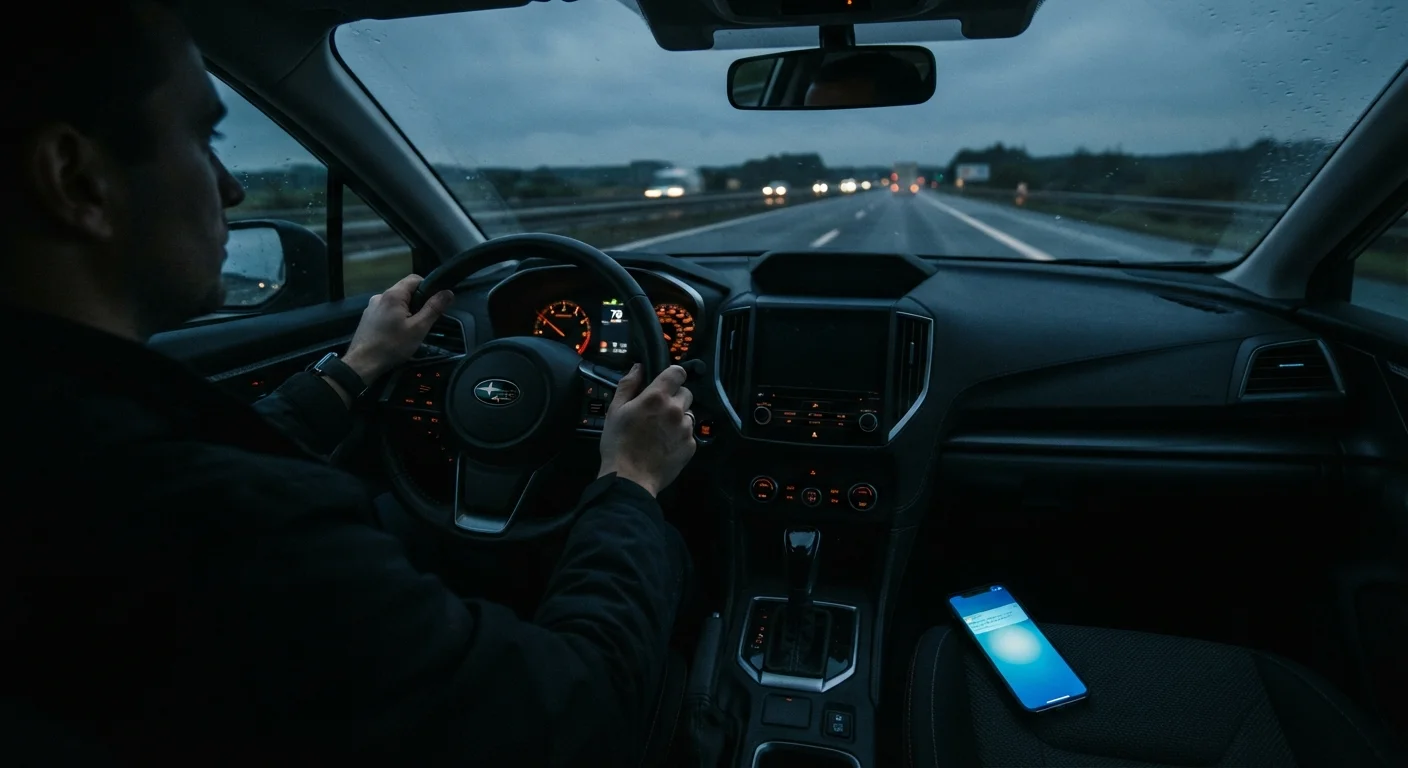
The danger of phone use while driving isn't primarily about where your hands are - it's about where your mind is. Studies from the University of Utah and the AAA Foundation for Traffic Safety have found that hands-free calling produces a measurable increase in cognitive load that degrades driving performance. Drivers miss visual cues, scan the road less effectively, and respond more slowly to events in their peripheral vision. The phone is held differently, but the mental conversation is identical. Laws permitting hands-free use may reduce legal risk, but they don't eliminate crash risk.
Myth
Glancing at your phone for just a second or two is essentially harmless.
Fact
At highway speeds, two seconds of inattention means traveling roughly 175 feet - more than half the length of a football field - without monitoring the road.
NHTSA data has consistently shown that taking your eyes off the road for even two seconds doubles your crash risk. Reading or sending a text message takes an average of five seconds, during which a vehicle traveling at 55 mph covers the length of a football field entirely blind. The brain doesn't pause and buffer incoming hazard information while your eyes are down - it simply misses it. What feels like a brief glance is, in traffic terms, an extended period of blind travel.
Myth
Experienced drivers can multitask behind the wheel - their skill compensates for distractions.
Fact
Driving experience does not meaningfully protect against the cognitive impairment caused by distraction. The brain cannot genuinely perform two attention-demanding tasks simultaneously.
The concept of multitasking, as most people understand it, is largely a myth - the brain rapidly switches between tasks rather than running them in parallel. In driving contexts, that switching introduces gaps in hazard monitoring. More experienced drivers may handle routine vehicle control with less conscious effort, but monitoring a dynamic, unpredictable environment is a high-attention task that experience doesn't automate. Overconfidence in one's own ability to multitask is itself a documented risk factor. Familiarity with a route can also reduce alertness, making distraction more likely rather than less consequential.
Myth
Voice-to-text technology is safe because it eliminates the need to look at or touch the phone.
Fact
Voice-activated technology reduces manual and visual distraction but still imposes significant cognitive demands that impair driving performance.
AAA Foundation research has rated voice-based systems - including those built into vehicles - as moderately to highly cognitively demanding, depending on how well the system understands the user and how many corrections are required. Drivers using voice commands show reduced scanning of the environment and slower response to peripheral hazards. The technology is a meaningful improvement over manual texting, but it is not a distraction-free solution. Composing a message, even by voice, keeps part of your attention anchored to the phone task rather than the road.
Myth
Passengers are as distracting as phone calls, so there's no real difference.
Fact
Passengers and phone callers behave very differently. Passengers observe road conditions and naturally pause conversation during complex traffic situations; remote callers have no awareness of what's happening around the car.
Research has found that in-person passengers often modulate their conversation in response to driving demands - they pause when traffic is heavy, alert the driver to hazards, and can take over navigation tasks. A phone caller has no visibility into the driving environment and maintains a steady conversational demand regardless of what's happening on the road. This is one reason studies find that passenger conversations impose less cognitive burden on drivers than equivalent phone conversations, particularly in challenging traffic conditions.
The Research Picture: Attention Is Not Unlimited
A core finding from decades of cognitive science is that human attention is a finite, shared resource. When you allocate mental bandwidth to a phone conversation, you withdraw it from the visual processing and hazard-detection tasks that safe driving demands. This isn't a matter of skill or experience - it reflects how the brain is structured.
~3,300
Distraction-related traffic fatalities per year (US)
NHTSA estimates thousands of annual traffic deaths involve distracted driving, with the true number likely higher due to underreporting.
2x
Increased crash risk from a 2-second eyes-off-road glance
NHTSA and Virginia Tech Transportation Institute research found that looking away for two seconds roughly doubles crash or near-crash risk.
~27%
Drivers using handheld phones at a given moment
NHTSA observational surveys have found that a notable share of drivers are engaged with handheld devices during daytime hours at any given time.
Distraction overlaps meaningfully with other road risks. Drivers already compromised by fatigue, for instance, are even more vulnerable to the additional cognitive burden of a phone call or in-car screen. Our article on drowsy driving warning signs explores how impairment compounds when alertness is already low.
Stopping distances are also directly affected - a distracted driver who detects a hazard half a second late is traveling significantly farther before braking begins. The physics are unforgiving, as explained in our piece on stopping distances and reaction time.
No Technology Makes Phone Use While Driving Safe
Neither hands-free calling, voice-to-text, nor dashboard-integrated systems eliminate the cognitive distraction of using a phone while driving. The safest choice remains pulling over safely before making or answering calls, and keeping all non-driving tasks for when the vehicle is parked. If your route depends on navigation, set it before moving and use audio guidance rather than glancing at the screen.
Reducing distraction also pairs naturally with broader defensive driving habits. Defensive driving principles are built on the assumption that your attention is fully available - distraction dismantles that foundation before the journey starts.
Tailgating Amplifies Distraction Risk Severely
Following another vehicle too closely already shrinks your available reaction window. Add even a momentary distraction, and that window disappears entirely. If you're in the habit of driving at close following distances, distraction makes a rear-end collision far more likely. Our article on why tailgating is more dangerous than drivers realize explains the physics behind this compounding risk.