
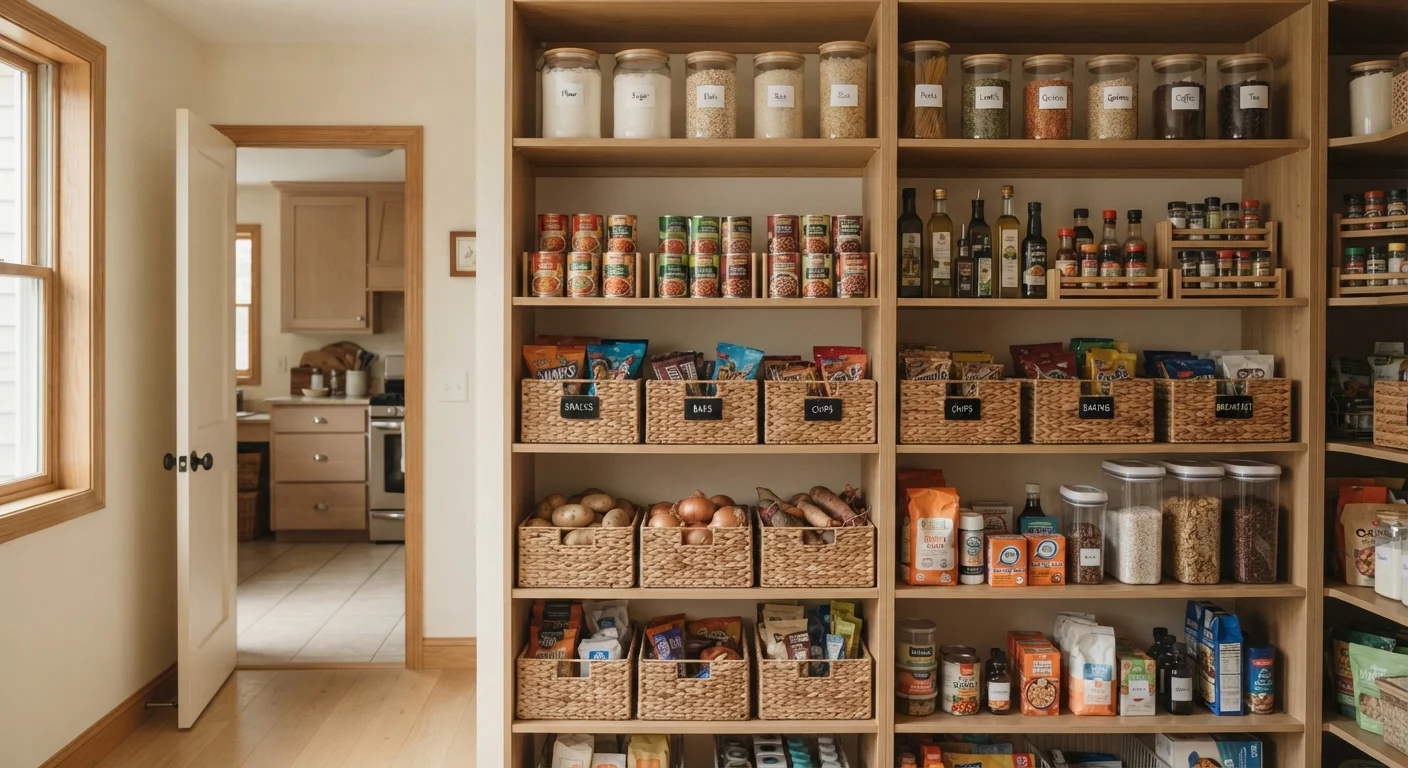
Why Most Pantry Systems Fall Apart
Most pantry organization attempts fail not because the initial setup was wrong, but because the system didn't match how the household actually cooks and shops. A beautifully arranged pantry built around idealized habits will slide back into chaos within weeks. The fix isn't more containers - it's better principles.
If you've ever reorganized a pantry and found it chaotic again two months later, you're not alone. Our article on why organized spaces fall apart explores exactly this pattern and what breaks the cycle. The short answer: systems that ignore real behavior don't survive contact with real life.
Zone your pantry by use frequency, not by food category alone.
Organizing purely by category (all cans together, all grains together) sounds logical but ignores how often you actually reach for things. Placing daily-use items at eye level and arm's reach dramatically reduces friction and the urge to pull everything out. Rarely used items can live on high or low shelves without disrupting daily cooking.
Prioritize visibility over storage capacity.
Items you can't see don't get used - and eventually get forgotten, expire, or get bought again unnecessarily. A pantry crammed full but poorly visible generates waste and frustration. Slightly less storage used well outperforms maximum storage used poorly.
Designate a clear 'landing zone' for new groceries before they're put away.
Unpacking groceries directly onto random available shelf space is how zones collapse. A temporary staging area - even just one specific shelf - lets you check what's already stocked and rotate older items to the front before adding new stock.
Match your container system to what you actually buy, not the ideal version of your pantry.
Decanting everything into matching jars looks appealing but creates work if your pantry holds many different package sizes or if you shop inconsistently. Choose containers that genuinely fit what you stock regularly. Partial systems - decanting only pasta, grains, and baking staples - often work better than all-or-nothing approaches.
Label storage locations, not just containers.
When every family member (or just a tired version of yourself) knows where things belong, items get returned correctly. Labeling the shelf or bin itself - not only the container - makes the system self-explanatory to anyone putting groceries away.
The Core Principles of a Lasting Pantry
Structural thinking - not aesthetic thinking - is what makes the difference. Before you invest in matching jars or label makers, establish these foundational habits and layouts.
Maintenance Is Part of the System
Even a well-designed pantry requires occasional resets. These aren't failures - they're normal. Plan for a brief monthly check: pull items forward, check expiration dates, and return things that have migrated to the wrong zone. Pairing this with your grocery routine (before a big shop, not after) keeps the effort small.
If your pantry shares space with a compact kitchen, the principles here overlap with broader small-space thinking. See our guide on smart storage for compact homes for strategies that scale down gracefully.
Pantry Resets Don't Have to Be Big
A full pantry overhaul is only needed occasionally - perhaps once or twice a year aligned with seasonal cooking shifts. Monthly resets are much smaller: a quick scan for misplaced items, a check of what's running low, and a wipe of any spills. Keeping resets short and regular prevents the buildup that leads to the dreaded full overhaul. Think of it less like cleaning and more like a brief weekly tidy applied to one specific space.
For those just beginning to tackle household organization more broadly, our beginner's home organization guide offers a calm starting point before tackling specific spaces like the pantry.