Why Mental Enrichment Matters for Small Pets
Small animals-rabbits, guinea pigs, hamsters, and companion birds-carry behavioral instincts shaped by millions of years of evolution. In the wild, a guinea pig forages through diverse terrain, a hamster caches food across a sprawling home range, and a parrot solves problems to access seeds hidden inside fruit. Captive life eliminates the pressures of predation and food scarcity, but it also strips away the cognitive and sensory variety those instincts evolved to navigate.
When enrichment is absent, the effects are often visible. Animals may pace repetitively, overgnaw enclosure bars, overgroom, or become lethargic and withdrawn. These are not personality quirks-they are behavioral indicators that welfare needs are not being fully met. Most small pets are prey species whose nervous systems are calibrated for continuous low-level alertness and exploration. That wiring does not disappear in captivity; it needs an appropriate outlet. To better understand the physiology driving these behaviors, see how prey animals experience stress-it is a useful lens for interpreting your pet's daily behavior.
Enrichment does not require expensive equipment or elaborate setups. It requires understanding what each species is motivated to do naturally, then providing safe, accessible opportunities to do versions of those things. The strategies below are organized by enrichment type, with species-specific notes throughout-because what engages a rabbit is not always what engages a hamster, and birds operate on a different behavioral framework entirely.
If you are newer to small pet care, our starter's overview of small pet ownership covers the housing, diet, and veterinary care basics that give enrichment its most effective context.
Enrichment Needs Vary by Species and Individual
What engages one species may be irrelevant-or even stressful-for another. Guinea pigs are highly social and need companionship as a baseline, while Syrian hamsters are typically solitary and can be harmed by cohabitation. Birds have cognitive demands that differ substantially from small mammals, and even within a single species, individual animals have distinct preferences. Observing your specific pet's responses, and consulting a veterinarian with small animal or avian expertise, will always be more reliable than any universal formula.
Before introducing any new enrichment item, verify that materials are non-toxic, free of sharp edges, and sized so that no piece can be accidentally swallowed. When in doubt about safety for a specific species, consult a veterinarian experienced with small animals or avian medicine.
Foraging Activities That Tap Into Natural Food-Seeking Behavior
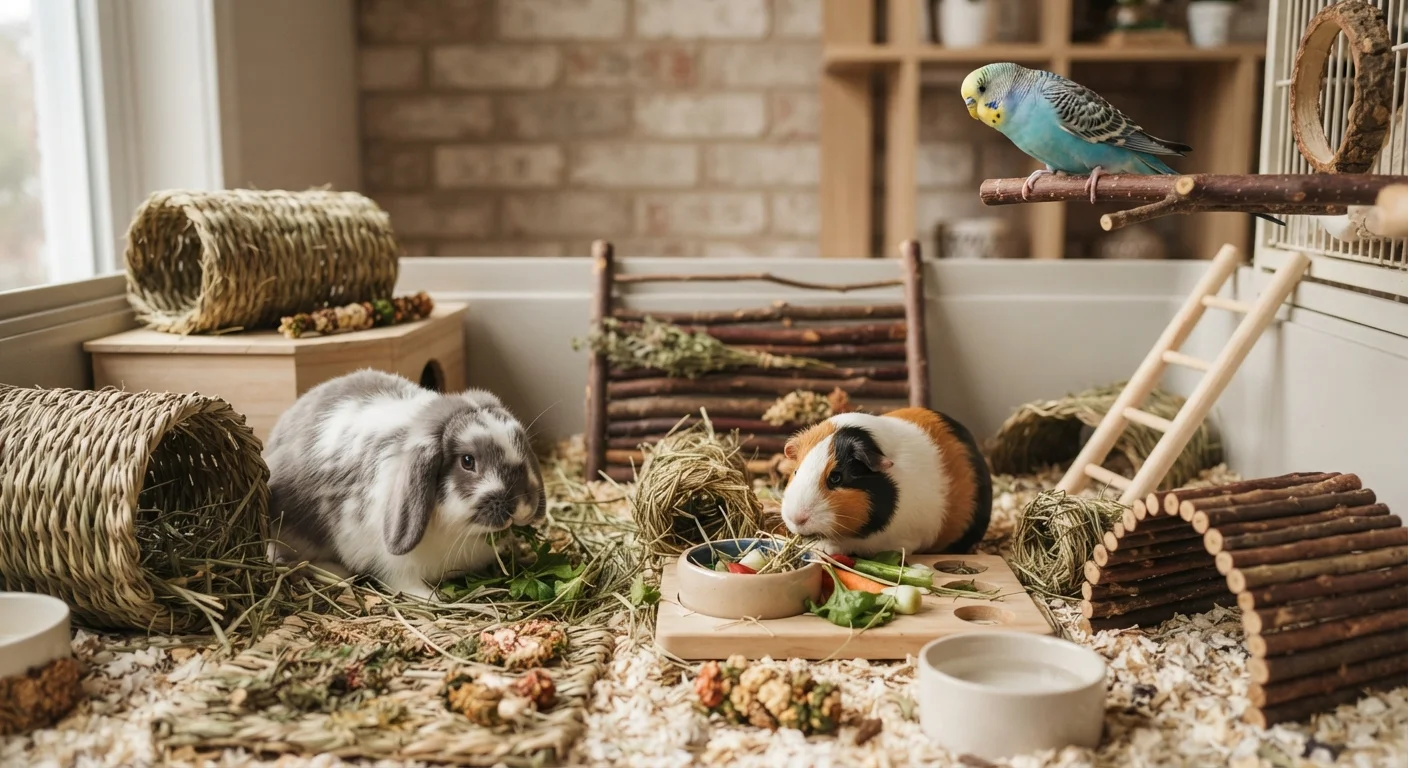
Foraging-actively searching for food rather than finding it in one predictable spot-is among the most powerful enrichment strategies available for small animals. Scatter a rabbit's or guinea pig's leafy greens throughout their enclosure rather than placing everything in one bowl. Hide a hamster's seeds beneath a layer of clean substrate (the loose material lining the enclosure floor) so they must dig and investigate. For birds, wrapping a small amount of food inside crumpled paper or tucking it inside a foraging cup mimics the problem-solving they perform in the wild. The result is a meal that takes time, effort, and cognitive engagement to obtain-exactly the kind of activity their behavioral repertoire is built around.
Foraging turns mealtime into a cognitive workout that mirrors natural food-seeking behavior.
Tunnels, Hides, and Burrow Opportunities
Prey animals need access to cover-not just for sleeping, but as a psychological resource that reduces baseline stress. Cardboard tubes, paper bag tunnels, wooden huts, and hay-built caves all serve this function effectively and at low cost. Rabbits benefit from tunnel systems they can move through; guinea pigs use hides as social meeting points and rest spots. Hamsters, which are naturally burrowing animals, benefit most from deep substrate that allows actual digging, though supplemental tunnels add useful variety on top. For birds, enclosure perches at varying heights-along with a small covered sleeping spot-provide the sense of elevated security their wild instincts favor. Avoid plastic hides with restricted ventilation or tunnels too narrow for the animal to turn around comfortably.
Access to cover is a psychological need for prey animals, not merely a comfort feature.
Chew Items and Destructible Enrichment
Chewing is both a dental necessity and a behavioral outlet for rabbits, guinea pigs, and hamsters. Untreated wood blocks or sticks from species known to be safe-such as apple or willow wood-dried hay wads, and woven grass mats give teeth something appropriate to work on while satisfying the urge to gnaw. Providing items specifically intended to be destroyed-plain cardboard boxes, paper bags, layered tissue paper-adds a satisfying demolition element that many small mammals find highly engaging. Inspect all chew items before offering them, and avoid anything painted, varnished, chemically treated, or made with adhesives. If you are unsure whether a specific wood or material is safe for your species, check with a veterinarian before use.
Destructible items satisfy both dental health needs and the natural behavioral drive to gnaw and shred.
Puzzle Feeders and Food-Based Challenges
Puzzle feeders slow down eating while requiring an animal to manipulate an object to access food-a two-for-one enrichment benefit. For rabbits and guinea pigs, a hay rack positioned at a slight distance from the main resting area encourages deliberate movement and extended grazing. For hamsters, placing food inside an egg carton compartment or beneath a lightweight wooden block creates a low-cost foraging challenge. Birds are among the strongest candidates for puzzle enrichment: many avian welfare specialists consider foraging puzzle time essential for parrots and cockatiels, which can learn to open latches, pull strings, or remove caps to retrieve rewards. Always introduce puzzles at the lowest difficulty level first to avoid frustration and ensure the animal can reliably succeed.
Puzzle feeders engage problem-solving instincts while making every meal an act of active participation.
Species-Appropriate Social Enrichment
Social structure varies enormously across small pet species, and enrichment plans must account for it. Guinea pigs are highly social animals that typically benefit from living in same-sex pairs or compatible groups; isolation from conspecifics (members of the same species) is widely regarded as a significant welfare deficit. Rabbits can thrive in bonded pairs but require careful, gradual introductions. Hamsters-particularly Syrian hamsters-are territorial and generally do better housed alone; forced cohabitation can cause serious stress and injury. Companion birds, especially parrots and cockatiels, have complex social needs that may be met by another compatible bird, consistent human interaction, or both, depending on the species and individual. For a fuller breakdown of social compatibility, see socializing small pets: what works for each species.
Social enrichment is foundational for guinea pigs but can be genuinely harmful for solitary-natured hamsters.
Environmental Rotation and Novelty
Animals habituate to static environments-the same layout, the same objects, the same smells-surprisingly quickly. Periodically rearranging the interior of an enclosure, swapping enrichment items in and out on a rotating schedule, or introducing novel safe objects (a new cardboard box, a different textured surface, a bundle of dried herbs) can restore exploratory motivation without significant expense. Novel scents are particularly effective: a small amount of dried lavender or fresh parsley placed in one corner of a rabbit or guinea pig enclosure often triggers sustained investigation. Rotate items roughly weekly rather than all at once to keep the environment interesting without overwhelming the animal with too much change simultaneously.
Rotating enrichment weekly prevents habituation and costs nothing beyond consistent attention.
Supervised Out-of-Enclosure Exploration Time
For many small animals, supervised time in a safe space outside their primary enclosure is one of the most valuable enrichment opportunities available. Rabbits benefit from access to a rabbit-proofed room or a large exercise pen where they can run, perform binkies (the spontaneous leaping and twisting behavior associated with positive welfare in rabbits), and investigate freely. Guinea pigs enjoy playpen time on the floor with scattered vegetables and tunnels arranged for exploration. Birds that are flight-capable and socialized to their owners can benefit from supervised free-flight time in a fully secured room. Before each session, check the area carefully for hazards-exposed wires, toxic houseplants, gaps where the animal could escape, or other household pets that could cause stress or injury. Active supervision throughout the session is essential.
Out-of-enclosure time offers physical and sensory variety that no enclosure setup can fully replicate.
Building an Enrichment Routine That Sticks
Enrichment works best when woven into daily routine rather than offered sporadically. Begin with one or two strategies from the list above, observe your animal closely over the following days, and note which activities they engage with most-sniffing, manipulating, or repeatedly returning to an item are all positive signals that an activity is meeting a real behavioral need.
Rotate items on a regular schedule to preserve novelty. Familiar objects stop being stimulating once an animal habituates to them; reintroducing the same item after a week or two away can reignite interest at no additional cost. For social species like guinea pigs, companionship is itself a form of enrichment that no toy can fully replace. For guidance on compatible pairings and safe introductions, see what works for socializing small pets by species.
If behavioral problems persist despite consistent enrichment-particularly repetitive movements, appetite changes, or self-directed aggression-schedule a veterinary appointment. These patterns can reflect medical issues or welfare deficits that require professional assessment, not simply more enrichment. They may also signal that primary needs-appropriate housing space, correct diet, or species-appropriate companionship-are not being fully met. Enrichment supplements good baseline care; it does not substitute for it.
Keep a Simple Enrichment Log
Jot down which enrichment activities your pet engages with most, and note when items were last rotated in or out of the enclosure. Even brief weekly observations help you spot patterns-such as consistently ignored items or activities that reliably generate the most exploration-and prevent the gradual habituation that develops when an enrichment routine becomes too predictable.